DescriVedendo Brera


00 - Introduzione
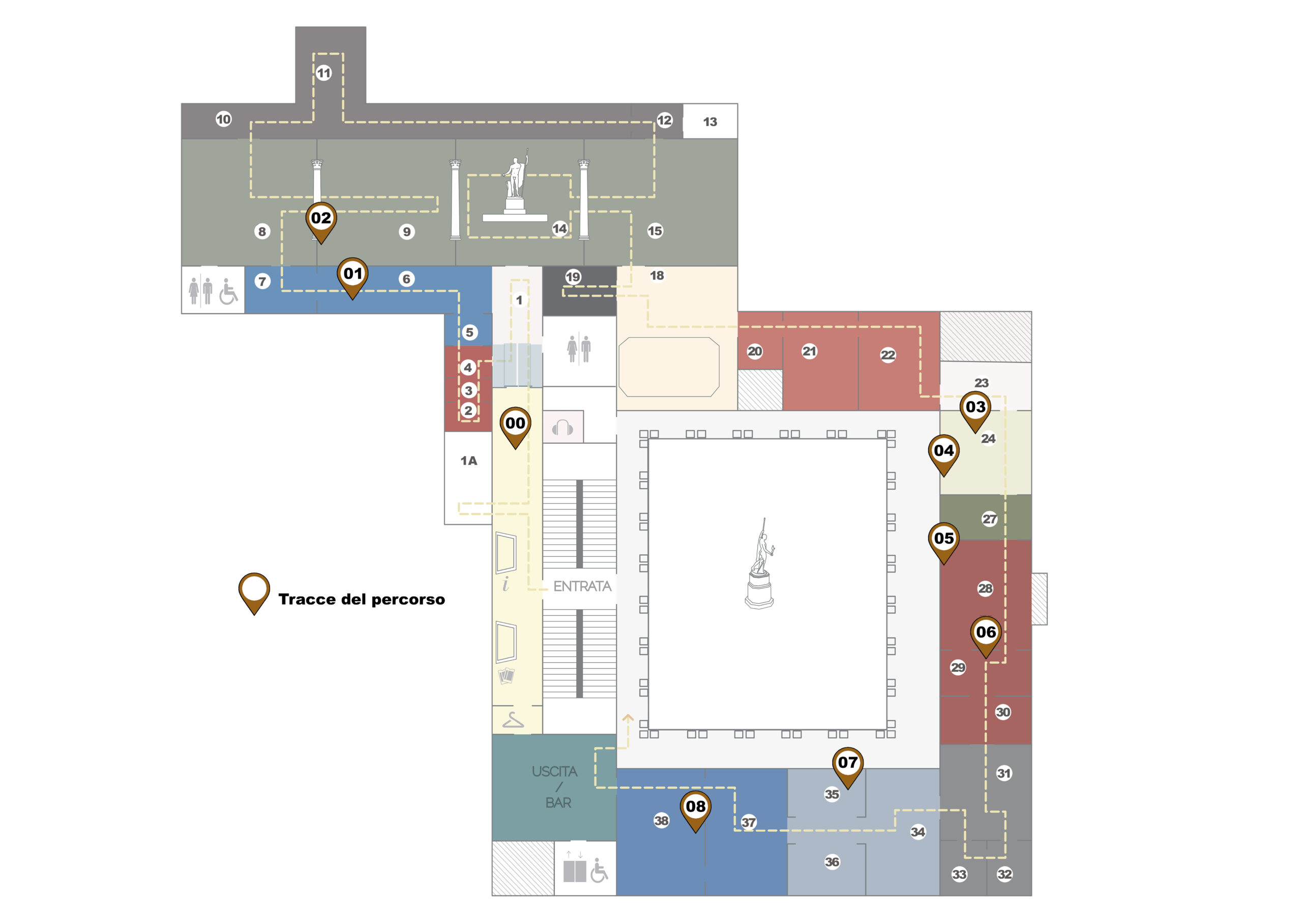
Walk along the entrance corridor, which is approximately 40 metres long in total, wide and well lit. About halfway along the corridor, you will find a large, full-height automatic glass door, which opens only in the central section and forms the actual entrance to the museum collections. This door consists of four glass panels. The two side panels are fixed, while the two central panels open automatically, sliding outwards and overlapping the side panels. To pass through the door, you therefore need to stay in the centre and take care not to head towards the side panels, which always remain closed. Just before the glass door, on the right, there is an opening leading to another small bookshop, also marked by a signpost about 1.5 metres tall. The museum is entirely on one level and has no steps or uneven surfaces, except for the low steps giving access to Rooms XXXV and XXXVI. The flooring in most rooms is Venetian terrazzo, composed of fragments of marble, granite, glass, and other natural stones of various colours, set in a lime or cement mixture with a glossy, polished finish; the overall tone is warm and rather light. Exceptions include the floors in certain rooms, which will be pointed out as you proceed. The rooms can be crowded and noisy due to the many visitors. Lighting varies from room to room and will be noted each time. The paintings are protected by dark grey metal spacers that project 30 to 40 cm from the wall, at a height of about 60 cm from the floor. An exception is the Napoleonic halls, mentioned later, which do not have spacers. The room numbers, written in Roman numerals, are located high up on one of the walls, so they are not easily spotted or readable. Most rooms are large spaces with high ceilings, occasionally occupied by objects that will be indicated as you encounter them, such as seating, statues, or temporary displays. The museum has three restrooms: one is located on the loggia, in the far right corner, facing the Gregotti Door; another is in Room I, right after the large automatic glass door, on the right; the last one is in Room VIII, in the far left corner. Walk along the last stretch of the corridor, then turn left to reach Room VI, where 15th-century Venetian works are displayed. Room VI consists of a corridor about 3.5 metres wide; the lighting is dim, while the paintings are brightly lit; the walls are vivid blue. Straight ahead of you, at the end of the room, stands the first described masterpiece: Lamentation over the Dead Christ by Mantegna.
01 - The Lamentation over the Dead Christ by Andrea Mantegna
Formal Description
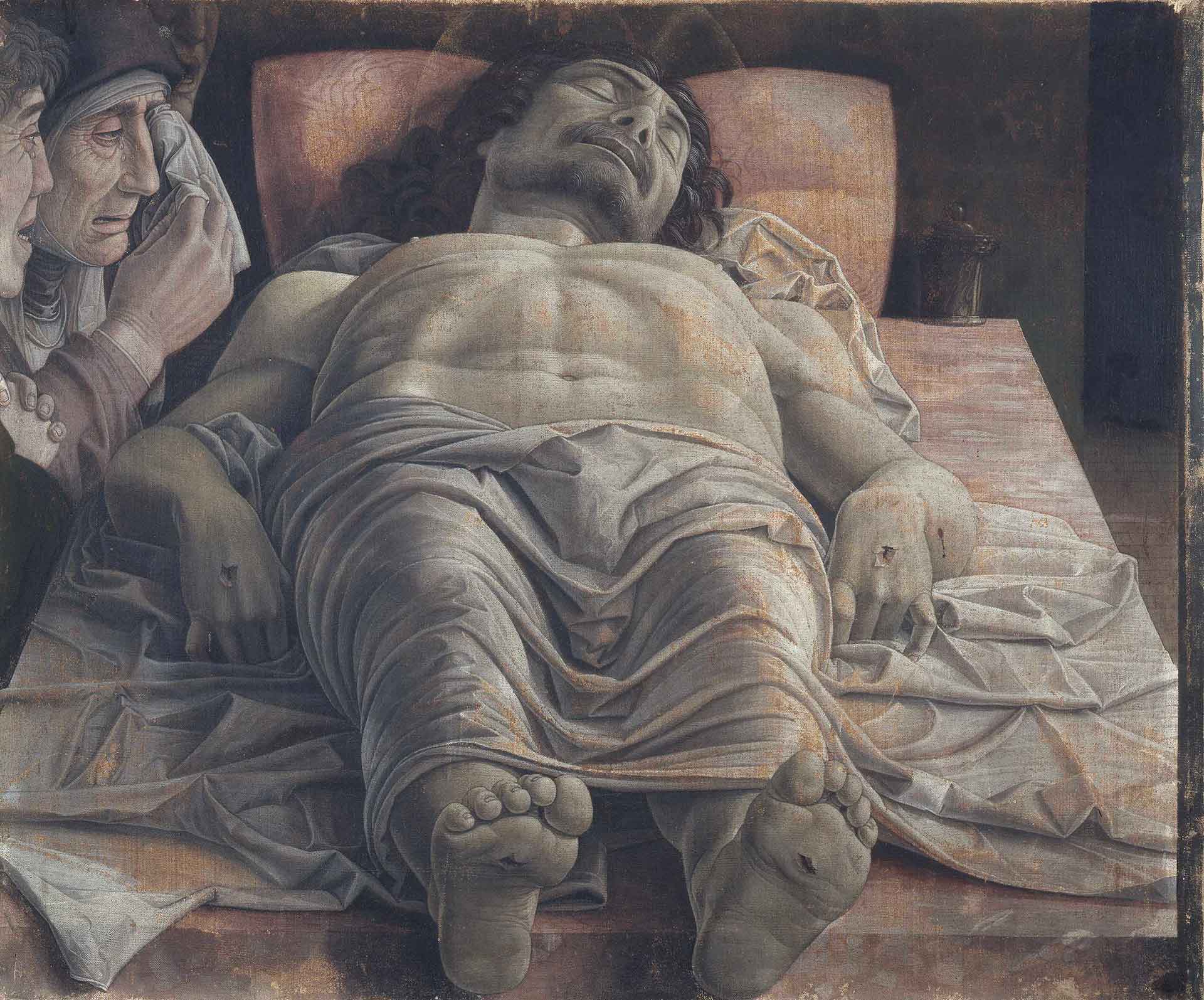
Christ Dead in the Tomb with Three Mourners is the official title of this picture painted by Andrea Mantegna, probably around 1483. It is a work in tempera on canvas painted in a realistic manner and is quite complex to describe.The painting is rectangular in shape, its horizontal side slightly longer than its vertical side. It is 81 centimetres wide and 68 centimetres high.The scene depicted takes place in the tomb, where Jesus Christ’s lifeless
body has been laid on a slab of marble to be cleaned and oiled with perfumed ointment before burial. Besides Jesus, on one side of the canvas, we see the grieving faces of a man and two women.The physical presence of Jesus’s body dominates the painting, filling most
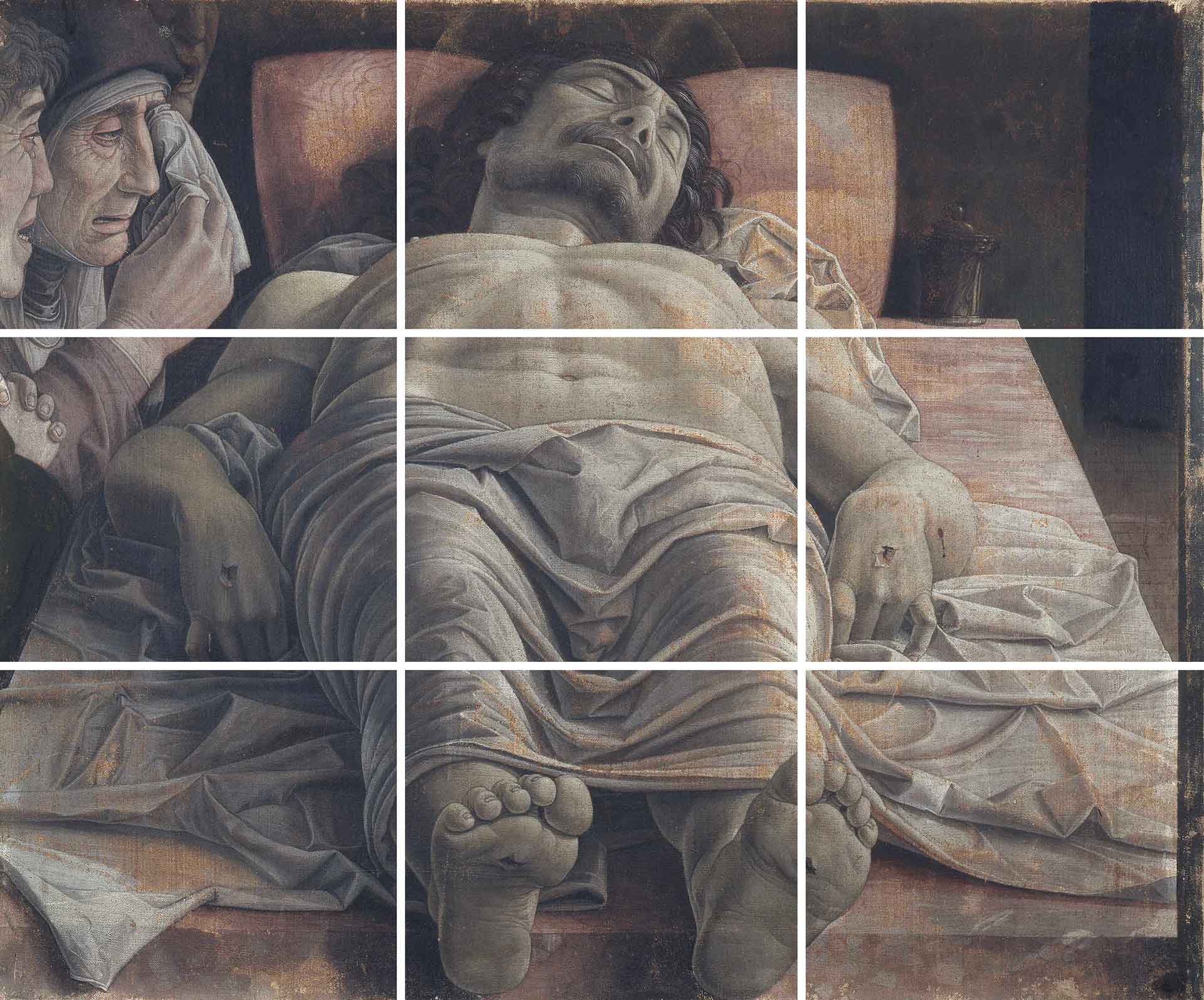
of the available space. Jesus is shown as though we were observing him from a slightly higher viewpoint, not by his side but facing him from the feet up. His body is thus painted entirely along the canvas’s vertical axis and so we see the soles of his feet in the foreground close to the lower edge, while if we lift our gaze we move up his body as far as his head in the distance, close to the upper edge. It is as though Jesus’s whole body were compressed between the upper and lower edges of the canvas: the painter depicts his anatomy realistically, but in a distorted manner in which he has slightly changed the dimensions of the body’s individual parts so as to make the perspective he adopts believable.To make it easier to understand the painting, we should now try to imagine it split into 9 equal sections obtained by crossing three columns with three lines, like a noughts and crosses grid. We can number the sections using a telephone keypad layout from left to right: 1, 2, 3 above; 4, 5, 6 in the middle; and 7, 8, 9 below.We can start our examination of the painting with the section closest to us.In the lower central part of the canvas, in section 8 and partly also in section 9, we have Jesus’s feet facing us, protruding beyond the slab of white-veined red marble on which his body has been laid. On both soles we can clearly see where his feet were pierced by the nails driven through them to nail him to the cross. In fact we can even see the raised folds of torn skin around the edges of the wounds.Moving up from section 8 to section 5, our gaze travels over the outline of his straight, parallel legs covered in a white shroud, or sheet, reaching to his hips. The shroud, with its many folds, extends beyond the sides of his naked body, clinging almost completely to it, as far as the edges of the marble slab.Jesus’s forearms and hands rest lifelessly on the shroud. His hands, with the palms facing downward, are half-open and his knuckles are resting on the shroud. We can see the holes that the nails made in the flesh on the back of his hands, as well. His arms are slightly bent at the elbows and we can perceive the muscle structure beneath the skin of his arms and on his chest, while his ribcage frames his almost concave stomach.Lastly, in the upper central part of the canvas, in section 2, we see Jesus’s head inclining to the observer’s right, framed by a very thin golden halo and resting on a cushion of the same reddish colour as the slab of marble. His eyes and lips are closed and his stubbly beard and moustache are barely hinted at while his long, wavy dark hair frames his face. At the top of the slab, in section 3, we see a small, dark marble container holding the perfumed ointment for anointing the bodies of the deceased before burial. In section 1, in the upper left-hand corner, more or less level with Jesus’s face, we see the grief-stricken faces of three figures, a man and two women. The man, closest to us, is St. John the Evangelist, weeping as he gazes at Jesus. We can only see part of his face in profile, with short dark hair. His mouth is open, a tear runs down from his half-open eyes, and his hands are crossed on his chest. Behind him we see Jesus’s mother Mary, wiping her eyes with a white handkerchief. She is old, her skin is deeply lined, her head and neck are swathed in a light-coloured cloth and a dark mantle is draped over her head. The woman behind Mary is traditionally identified as St. Mary Magdalen. We can only see the lower part of her face, from the nose down. Her mouth is open in an expression of grief. The backdrop to the scene consists of a grey-brown wall opening up onto a totally dark space in section 3, in the upper right-hand corner.The pale light illuminating the scene comes from an invisible source situated at 2 o’clock, emphasising the shadows cast by the bodies and highlighting the folds in the shroud.The artist achieves the composition’s dominant hue, with its earthy nuances, by using dull, opaque colours that help to shroud the scene in a sorrowful atmosphere. Parts of the linen canvas on which the picture was painted show through in several areas, with colours midway between ochre and orangey yellow. The formal description, drafted in February 2019 was produced by the Pinacoteca di Brera’s Education Departmentin conjunction with the DescriVedendo team and with the not-for-profit Associazione Nazionale Subvedenti, thanks to the support of the Lions Clubs International Milano Borromeo and Milano Duomo.
Art Historical Description
Mantegna, who was court painter to the Gonzaga family, the Dukes of Mantua, for over forty years, painted the Lamentation over the Dead Christ around 1483. The painting, which was probably intended for his own private devotion, is thought to have been devised at the time the relic of the Stone of Unction – on which Jesus’s body is reputed to have been laid so that it could be anointed with perfurmed ointment before burial – reached Mantua from Turkey. The scene shows the body of Christ lying on a hewn stone with his mother, the apostle John and a third, almost invisible figure half-hidden in the shadows, grieving over it. We are struck by the skilful handling of perspective giving us a foreshortened view of a supine body seen, the painting’s true focus, from the front. Mantegna was not new to this kind of experiment, having already tried his hand at it in his first major works in Padua. The cherubs staring down at us through the hole in the ceiling in the Camera Picta (Painted Chamber) in Mantua reveal the artist’s interest in this bold approach to perspective and set the Lamentation in the context of his development of what was a consistent feature of his artistic career. In this case Mantegna very probably resorted to the “parallel projection” technique permitting the foreshortened depiction of a horizontal body without it appearing excessively distorted. So we may consider the Lamentation to be a visually effective depiction, its minor incongruities being due to the artist’s wish to show the various parts of Christ’s body in proportion so that the overall figure can still be appreciated without the feet, for example, being far larger than the head.The immense popularity that Mantegna’s bold experiment was to enjoy with painters of the 16th and 17th centuries is apparent in another painting in the Brera collection, Tintoretto’s Miracle of St. Mark, and in the echoes we find of it in work by artists of the Bologna school or by Caravaggio’s followers, for instance Annibale Carracci and Orazio
Borgianni. The painting’s history is somewhat intricate and at times even mysterious. It was discovered by Mantegna’s son Ludovico in his father’s workshop on his death in September 1506. Mantegna was heavily in debt when he died and so Ludovico begged the Gonzaga family to purchase some of his paintings. A “foreshortened Christ” ended up in Duchess
Margherita Paleologa’s dressing chamber in the Ducal Palace. When the Gonzaga collection was sold off in 1627, Mantegna’s picture passed through several private collections before Giuseppe Bossi, the Secretary of the Accademia di Belle Arti di Brera, bought it in Rome in 1801 with the idea of bringing it back to Milan to add to his collection. The painting finally joined the Pinacoteca di Brera’s collection for good on 3 July 1824, after lengthy negotiations between Bossi’s heirs and the Accademia di Brera.
Biography
Andrea Mantegna was born into a family of carpenters in Isola di Carturo, now known in his honour as Isola Mantegna, in the province of Padua in 1431. He was apprenticed to Francesco Squarcione’s workshop in Padua at the age of ten. During his time in Padua he met Antonello da Messina, Flemish and Tuscan painters and Donatello and his assistants working in the Basilica of St. Anthony. He himself painted a cycle of frescoes in the Ovetari Chapel and the San Zeno Altarpiece for the church of the same name in Verona. He married Nicolosia, Giovanni and Gentile Bellini’s sister in 1453, when he was 22 years old, thus consolidating his bond with the Bellini family of Venetian painters. Ludovico II Gonzaga invited him to settle in Mantua in 1460, offering him board, lodging and a generous annual salary. Mantegna was to remain at the ducal court until his death in 1506, and it was there that he producedhis most celebrated masterpieces, the works on which his reputation still
rests today: the Camera Picta (Painted Chamber) in the Castello di San Giorgio, the Triumphs of Caesar, the Studiolo of Isabella d’Este and the Lamentation over the Dead Christ.He is buried in a chapel in the church of Sant’Andrea surmounted by a bronze portrait in the classical style which he himself designed and modelled.
02 - The Finding of the Body of Saint Mark by Tintoretto
Art historical description
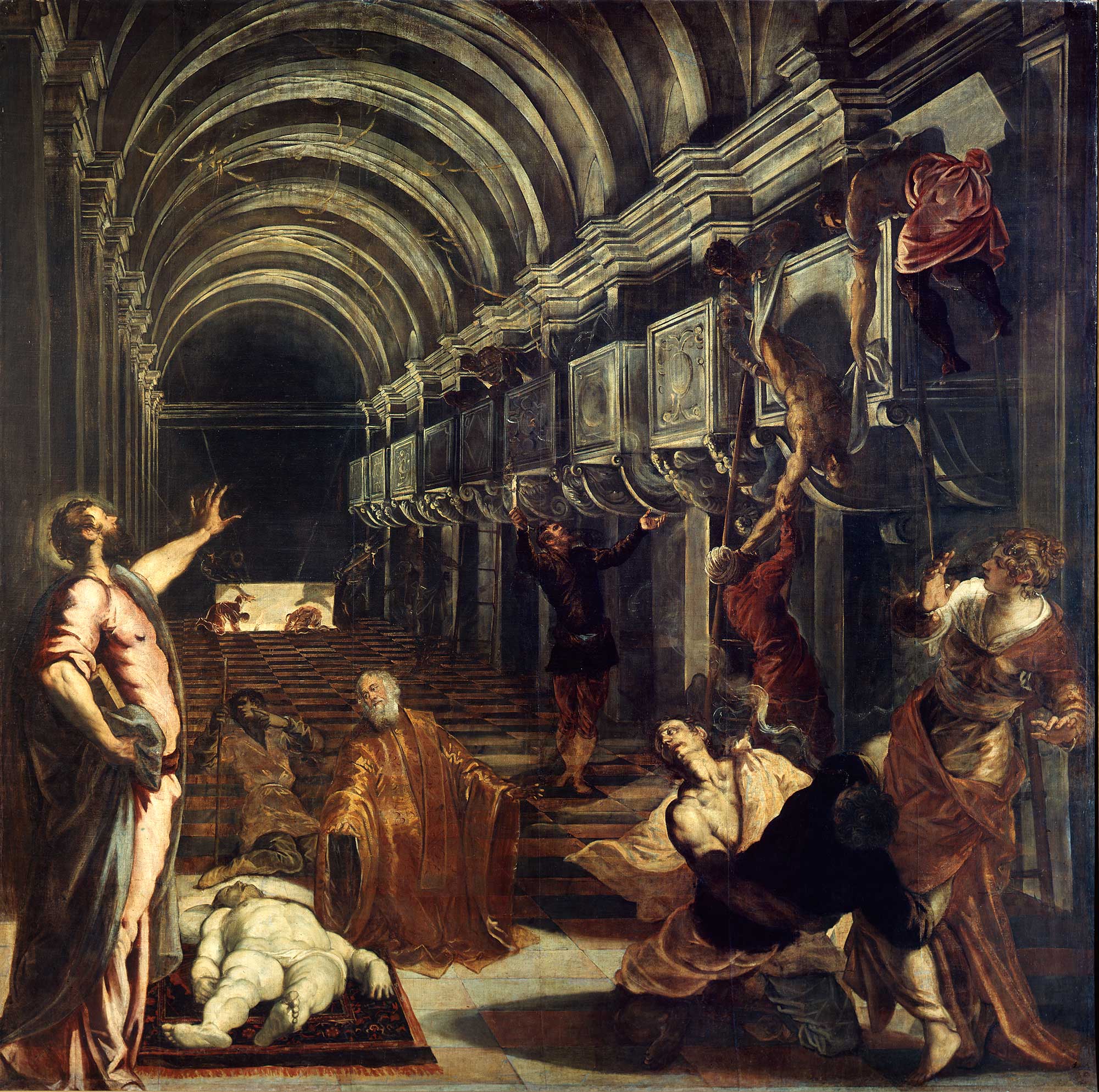
With the skill of a great director, Jacopo Robusti, called Tintoretto, tells with a single image the adventurous events related to the discovery of the body of Saint Mark in Alexandria of Egypt. We are in what seems to be the nave of a church where a search for a body among the tombs is taking place. Among the searchers, there are the two Venetian merchants
Buono da Malamocco and Rustico da Torcello, charged with exhuming the remains of the body of Saint Mark, martyred in the Egyptian city, and to bring them to Venice, where the
saint was highly revered. The climax of the scene is fixed by the painter in the eloquent gesture of the character in the foreground, Saint Mark, who appears and who, raising his left hand, stops the search. The body has been found and lies, pale and lifeless, before his feet on an Eastern-style carpet, and is painted in a strongly foreshortened pose that strongly
recalls the Dead Christ by Mantegna. The miraculous apparition of the saint is followed by the episode staged by the excited group of characters who, one clinging to the other, occupy
the foreground to the right of the picture: a gush of smoke comes out of the mouth of one of the two men, the exorcism is accomplished, the man is freed from the devil thanks to the
thaumaturgic power of the body of the saint just found. Kneeling in the center, the patron of the work, Tommaso Rangone, attends the scene wearing the long and precious tunic of
“Golden Knight”. It was 1562 when the doctor, astrologer and mathematician from Ravenna was appointed Guardian Grande of the Scuola di San Marco. Perhaps the work, which is
part of a cycle of three canvases, was commissioned to Tintoretto to celebrate the event.
The cycle, dedicated to the life of the saint and his miracles, also included, together with the painting exhibited in Brera,The Removal of the body of Saint Mark and Saint Mark saving a Saracen from shipwreck, which today are at the Gallerie dell’Accademia in Venice. The Venetian Scuole were important city institutions, having welfare and charitable purposes, and the most prestigious ones could afford beautiful locations, decorated by the most famous artists of the time. Jacopo had entered the list of these at least since 1548, when his extraordinary large canvas The miracle of the slave appeared, to decorate The Chapter House of the Scuola Grande di San Marco. The finding of the body of Saint Mark is a crowded picture and it is permeated by a strong dynamism: everything is in motion, everything happens in the same moment. The architecture fully participates in this general sense of motion: a long, deep space without openings, probably the fruit of the vivid imagination of the painter, marked by the very fast perspective escape of the vaults and by the orthogonal lines of the checkerboard floor that converge towards the bottom. But looking closely, all the geometric lines of architecture are generated by the gesture of Saint Mark’s hand; it is as if everything was built around it. Spatial setting no longer functions as an organizing grid or as a background of the composition as in the Renaissance, but it becomes a means of expression that excites and attracts the gaze of the viewer.
Light is also used by the painter in a strongly dramatic sense; in the twilight there are flashes and reflections of dazzling light, the origin of which is not always clear. In a continuous alternation of lights and shadows, the figures of the protagonists stand out, each of which is illuminated in a particular way. The light touches the side of the woman’s body, it strikes in full the figure that holds the possessed man, left instead totally in the shadows. It reverberates on the precious clothes of Rangone and lingers on the cold pallor of the lying corpse. It profiles the sculptural figure of Saint Mark and it crystallizes his gesture. The figures are not posing, but they are always interrupted while they are performing an action and the light fixes that brief moment. The scene of the miracle is not there to be contemplated, but it is happening before our eyes. Made in a mature stage of the artist’s career, the entire cycle, of which this work is part, highlights the intent and peculiarities of his art: to realize a painting that is a fantastic vision, capable of upsetting and moving through the strong scenic sense with which his stories are permeated. The plastic vigor of the figures is enhanced by the chromatic and light contrast, and his ability as a designer proves to be able to bend figures and spaces according to the most daring views.
Formal description
The Finding of the Body of Saint Mark is the title of this work painted by Jacopo Robusti, known as Tintoretto, between 1562 and 1566. It is an oil painting on a very large and square
canvas: it measures about 4 meters, both in width and height. The main figures, in the foreground, are slightly larger than real life and the subject is depicted in a realistic manner.
Looking at this painting you have the feeling of being inside a stage and taking part in the scene. The picture describes an episode, datable around the year 825, in which Mark
appeared to some Venetian merchants who were in Alexandria of Egypt, a city where he had been killed and buried in the 1st century. The merchants are depicted here as they uncover graves in search of the body of the saint, which they will then take to Venice. Saint Mark is portrayed twice in the canvas: one in the form of an apparition, standing; and a second lying down, as the corpse is finally found. The scene takes place in a dark interior, a large and rather deep place, where only some areas are illuminated. The shape and the size of this space recall the nave of a church. Several tombs are placed high and in a row, protruding between the pillars and another on the wall to the right of the observer, while the ceiling is curved and punctuated by a succession of barrel vaults. The floor is composed of square slabs arranged as on a chessboard, alternating black and brown. The main characters are all in the lower half of the canvas. To better describe the work, let’s imagine it divided into 9 sectors of equal size, obtained by imagining three columns with three rows.
In each sector, by convention, we give the numbering used in telephone keyboards. From left to right: 1, 2, 3 up; 4, 5, 6 in the middle; 7, 8, 9 below. Let’s start with the description of what is closest to us.
The protagonist of the scene is the figure of Saint Mark who appears, physically imposing, standing in the foreground in sectors 4 and 7. He is in profile, and he has short hair and dark brown beard, his head is surrounded by a halo painted as a bright circle; he has his left arm extended forward and upwards, and his hand open in a determined gesture to stop the
action around him. The whole painting revolves around this hand, which is located in the center of sector 4 and corresponds to the vanishing point of the perspective towards which
all the depth lines of the scene converge. In this way in the composition there is a strong tension towards the left, which gives the observer the feeling of being dragged into the
painting. Under Saint Mark’s bent right arm there is a book, perhaps the gospel written by him; his hand is placed on his side to hold a blue cloak that leaves his shoulder uncovered;
under this he wears a pink tunic, clinging very tightly to his chest and long enough to reach the ground. At the foot of the apparition of the saint, there is his corpse. He is lying on the floor on an Asiatic carpet, with his head resting on a light-colored pillow. The body, of a cold white color, is naked and with well-delineated shapes. A thin light cloth covers the groin. Tintoretto paints the body, which seems shortened by the strong perspective, with the soles of the feet facing us. Between sectors 5 and 8, near the corpse of Saint Mark, is portrayed the patron of the painting, Tommaso Rangone, kneeling on the ground with his arms lowered and open as a sign of devotion: he has white beard and hair and is dressed in a long robe of copper gold, with very wide sleeves and a band, golden as well, which comes down from the left shoulder. Still in the foreground, but in sectors 6 and 9, we find a group of three intertwined figures: two men on their knees and a standing young woman.
Of the three, the standing woman is the closest to the right margin of the canvas; she is unbalanced towards us because of the man clinging to her legs, who is the center of the group and has his back to us; the other, on the opposite side to the woman, holds the first man around the waist from behind, to push him away from her. We recognize the man in the center as possessed: from his mouth in fact we can glimpse threads of white smoke that come out and twirl to the ceiling to form the barely perceptible contours of an
anthropomorphic figure facing downwards. The woman, turned towards Saint Mark, shows her left profile. She wears an elegant beige and amber dress and she follows with her eyes
the demonic fumes rising upward. The man kneeling in the center wears a dark dress, while the one who restrains him twists his face towards Saint Mark and is wearing a yellow cloak,
which leaves partially uncovered his chest and right shoulder. Just behind these figures in the foreground, in the twilight between the apparition of Saint Mark and the patron, there is a man kneeling and leaning back who holds with his right hand a long and thin stick, while with his left he indicates his own face, perhaps his miraculouslyhealed eyes or the spot on his cheek from which a plague of leprosy has disappeared. Behind this row of characters in the foreground, there is a wide space, in which we find other figures, of reduced size compared to those just described. In sectors 3 and 6, there are two men perched on ladders, on the sides of the first sarcophagus of the right wall, intent on lowering, using the shroud as a rope, a corpse to their companion on the ground, who grabs his arm; not far away, in sector 5, another man stands holding up a small candle, to illuminate the difficult operation. The same scene, but without the corpse, is repeated a little behind; it is just outlined and barely stands out in the general darkness. Finally, in sector 4, there are four other men searching: they raise the slab of a tomb to the floor and illuminate the interior with a torch. The foreground figures are depicted as tangible bodies, including the apparition of the saint. Others, on the bottom of the nave, appear instead rather spectral, with faintly outlined contours and an almost transparent consistency. The scene is dark overall, but in the dark there are three sources of light: one, very strong, comes from a source outside the painting at two o’clock, and stresses the volume of the foreground bodies and the architectural elements; the second is the torch in the hands of one of the men at the bottom of the scene, which illuminates the inside of the tomb, flush with the floor; the third is the dim candle in the hands of the man looking at the body lowered from the sarcophagus on the wall. The characters depicted in the foreground are predominantly in the tones of orange, red and yellow, and strongly contrast both with the dark colors of the background and with the waxy white of the corpse of Saint Mark.
Biografia
Known as Tintoretto because of the job of his father who was a cloth dyer (or “tintore” in Italian), Jacopo Robusti was born in Venice on an uncertain date, but according to his death
certificate, it should be around 1519. He spent his whole life in the lagoon city, apart from some documented trips to Padua and Mantua. Some sources report that he was sent to the workshop of Titian, but the Master, who was about thirty years older than him, once he realized the talent of the young Jacopo, fired him after a dispute. The episode, even if not true, gives us some indications about the life of the artist. His career took place, in fact, simultaneously and often in competition with that of Titian, the dominant personality in Venice at the time. His art was influenced as well as by the Venetian coloristic tradition of Giorgione and Titian, also by other artists of the same school, such as Bonifacio de’ Pitati, Paris Bordon or Andrea Schiavone. Florentine and Roman artistic innovations such as, for example, Michelangelo’s sculptures, which arrived in Venice thanks to the circulation of casts, drawings and prints, were further important contributions to Tintoretto’s artistic training. We know that at the age of twenty, around the year 1540, the painter was an independent master, with his own workshop, and he already carried out important works such as the ceiling decoration of the residence of the banker Vettor Pisani in San Paterniàn, with fourteen paintings focused on the theme of Ovid’s Metamorphoses.
In 1548 he began his relationship with the Scuola Grande di San Marco for which he painted The miracle of the slave, a work that can be considered his first great masterpiece, and that
stunned the whole city. From that moment his activity grew more and more; also his daughter Marietta and his sons Domenico and Marco worked with him in his workshop and he was involved in more and more important commissions. In fact, he continued his collaboration with the Scuola Grande di San Marco, for which he created the three big canvases depicting Saint Mark saving a Saracen from shipwreck, The Removal of the body of Saint Mark and The finding of the body of Saint Mark today in Brera. In these works of maturity his research preferred decentralized compositions, intense luminism and a drama very close to the art of theater. The “prestezza” (something like speed mixed with ability), with which he used to work and for which he was famous, is evident in the energetic and fast brushstrokes.
Always open to new experiments, around 1564 he began to work for the Scuola Grande di San Rocco, of which he was also a member. For this Scuola, in which he worked for about twenty years, Tintoretto painted an awesome cycle of over sixty canvases, with episodes of the Old and the New Testament. Known among his contemporaries as “the furious”, very prolific artist, in 1594, when he was over 70, Tintoretto still had the strength to dedicate himself to two great works for the Basilica di San Giorgio Maggiore, The Jews in the desert and the fall of manna and a Last Supper. He died on 31 May of that year and his son Domenico inherited the workshop.
03 - The Montefeltro Altarpiece by Piero della Francesca
Formal description
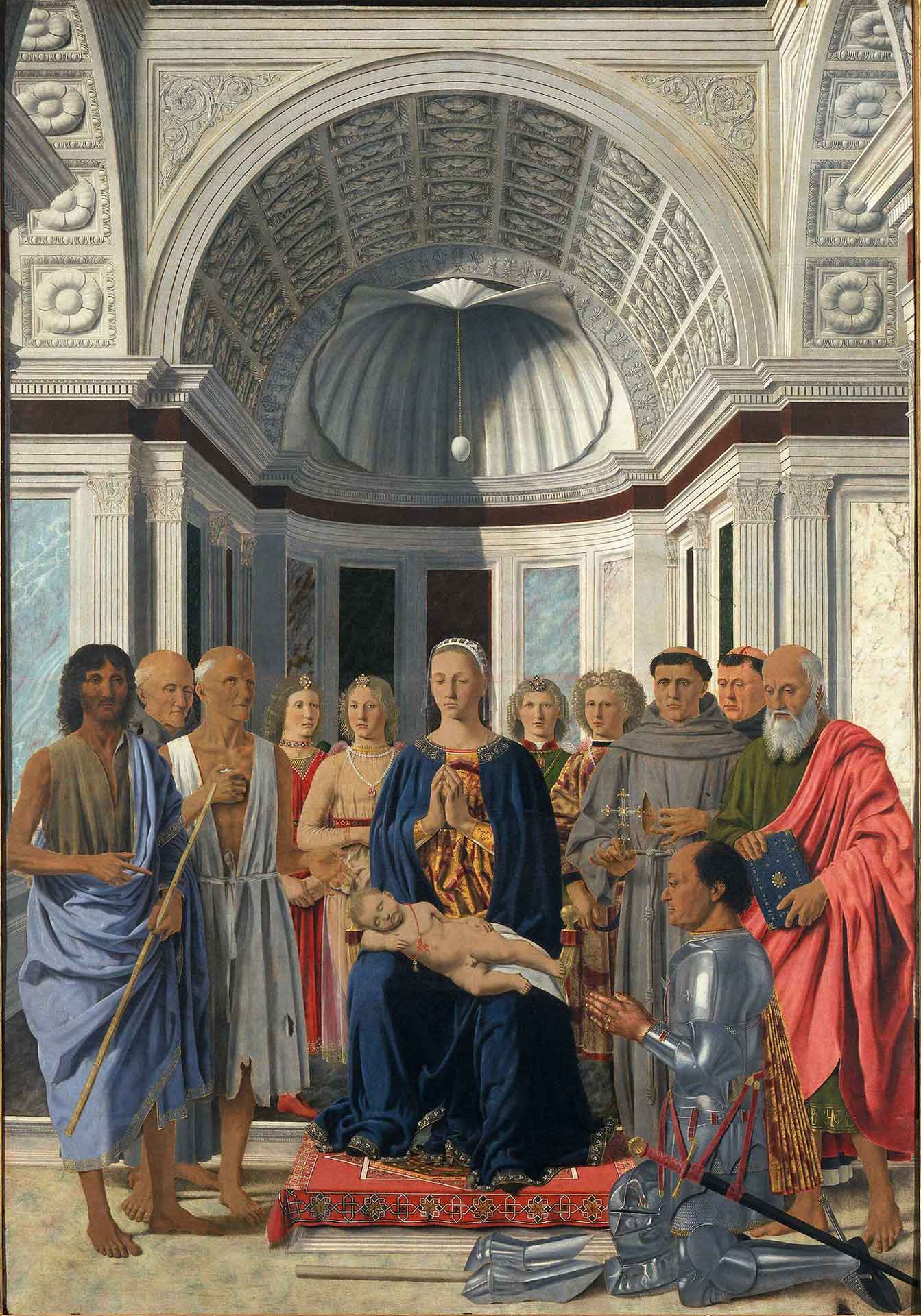
Madonna and Child with Saints, Angels and Federico da Montefeltro is the title of this
work painted by Piero della Francesca around 1472. The painting is also known as the
San Bernardino Altarpiece or Brera Altarpiece. It will take you about ten minutes to
read this description. This is a painting in tempera and oil on wood. The painting is
figurative, the painter reproducing forms and colours realistically and in correct
proportion. It measures 2.51 meters in height and 1.75 meters in width. Its shape is
therefore that of a large rectangle, its vertical side being the longer. The subject of the
painting consists of a group of people inside a church. The figures depicted are: Mary
on a throne with the Child Jesus, a group on either side of her, each group comprising
three saints and two angels. Kneeling in the foreground, on the viewer’s right, is
Federico da Montefeltro, who commissioned the work. All the characters wear a
serious and solemn expression. They are portrayed in full length and very close to
each other. They occupy the lower half of the painting, while the upper half is taken up
entirely by the architecture of the church. The point of view adopted is frontal, with the
perspective lines converging towards the face of Mary, thus making it the focal point
of the altarpiece. To best describe the work, let us imagine that it is divided into 9
sectors of equal size, obtained by crossing three columns with three rows. In each
sector, by convention, we assign the numbering used on telephone keypads. From left
to right: 1, 2, 3 up; 4, 5, 6 in the middle; 7, 8, 9 below. At the centre of the scene is
Mary, who occupies sectors 5 and 8: she sits on a throne set on a platform, but all we
can see of the throne are its two armrests. Mary is therefore set slightly higher than
the other figures. Her eyes are half-closed, her expression solemn and she is looking
down; her hands are joined over her chest and her left foot protrudes slightly from the
platform, which is covered by a red carpet with geometrical motifs. Her perfectly oval
face is framed by her hair, which is pulled back, held in place by white ribbons and
partly covered by a short transparent veil. Mary wears a sumptuous gold brocade
velvet dress with red motifs and a long dark blue mantle, finely decorated around the
neck and the lower hem, which covers her down to her feet. In sector 8 the Child
Jesus, lying on the legs of his mother and resting on the fur lining of her mantle, is
asleep on his right side and his body is almost completely turned towards the viewer.
The child is naked, wearing only a red coral necklace. His head rests in the crook of
his right arm and his right leg is slightly bent, while his other arm lies along his hip and
his left leg is extended. Three saints stand on Mary’s left and three on her right, set in
an almost symmetrical semicircle, two in the foreground and one behind them in the
middle.
In sectors 4 and 7 we find the first three saints. Starting from the left, in the front row,
we have St. John the Baptist, who is gazing at the observer. He is thin, with a dark
complexion, long curly brown hair and a sparse beard. He wears a dark beige tunic,
partly covered by a blue cloak draped over his left shoulder, and is barefoot; in his left
hand he holds a slender stick, while with his right he points to the sleeping baby Jesus.
Moving to the right, also in the first row but set slightly back we see St. Jerome. He is
an old man, bald and rather emaciated. His gaze is fixed on an indistinct point
somewhere above him. He wears a worn light grey tunic tied at the waist by a cord,
which leaves his chest bare. In his right hand he holds a stone with which he strikes
his chest as a mark of penance while with his left he, too, points to the baby Jesus.
Behind the first two saints, in the middle, stands St. Bernardino of Siena. We can see
only his almost completely bald head, and, below, his bare feet sprouting from his grey
habit. In sectors 6 and 9, in other words to Mary’s right for the observer, we find the
other three saints. St. Francis is closest to Jesus’s mother. He is tonsured, and through
an opening in his tunic he points to the wound in his side, while in his right hand he
holds a small rock crystal cross. Continuing to the right, we find St. John the
Evangelist, who is depicted as an elderly man, almost bald, with a long, white beard.
He wears a dark green tunic and a red mantle that leaves his right shoulder bare; he
holds a book with a richly decorated cover in both hands and his gaze is turned
towards Jesus. Between and behind the two saints, we can see the face of St. Peter
Martyr, who has a long wound on his shaven head, a mark of his martyrdom. He, too,
looks at Jesus.
Completing the group, in sectors 5 and 8, four angels stand behind Mary in the
background, two on the right and two on the left. They are depicted as young, blond
and richly dressed, with tunics in richly coloured fabrics. They all carry a jewel on their
hairline, gold necklaces and pearls. On their shoulders we see their closed wings and
it is this detail that tells us that they are angels. In sectors 9 and 6, in the foreground,
in front of the group of saints on the right, we see Federico da Montefeltro, the lord of
Urbino, who commissioned the work. He is on his knees, looking at Mary and Jesus,
thus facing towards the centre of the scene and showing us his left profile: he is almost
bald, with black hair stretching from the middle of his head to the nape of his neck,
and he has a pronounced, aquiline nose. The duke is absorbed in prayer, his hands
clasped in front of him. He wears shiny metal armour embellished by a short red and
yellow velvet cloak, and a sword hangs from his belt. On the ground, in sectors 8 and
9, we see his condottiere’s command baton, his gauntlets and his helmet with a large
dent in the visor.
The group of figures is set in a Renaissance church in which light grey is the dominant
colour. Behind the group, in the centre, we see a deep, enclosed space surmounted
by a barrel vault. The coffered vault is divided into rows, each coffer having a flower in
the centre. The reproduction of a large shell is set in the semicircular apse in the
background. From it, there hangs a chain with a white egg hooked onto it at the end,
appearing to form a vertical line above Mary’s head although it is in fact set a little
further back. In sectors 4, 5 and 6 the walls below the shell, though partly hidden by
the figures in the foreground, are faced with rectangular slabs of coloured marble,
interspersed with slender white pilasters protruding slightly from the wall. The same
architectural motif continues on to the end of sectors 4 and 6, hinting at openings on
either side of the building which are not visible in the scene depicted.
The light source, outside the painting, comes in from 10 o’clock. On the left shoulder
of Federico’s armour we can see the reflection of an arched window, suggesting that
the light comes from there. The whole composition is immersed in the white light of
daytime, producing shadows that lend prominence to the architecture and define the
three-dimensional nature of the forms, including the egg in sector 5.
The sharp, crystalline atmosphere of the painting and the static nature of the figures
impart a feeling of suspension and immobility to the composition as a whole.
Piero della Francesca chose to use a limited palette in which the greys prevail,
together with shades of blue and light blue and a few notes of red.
Art historical description
The Montefeltro Altarpiece is on display in room 24 of the museum, still reflecting the
layout devised by the architect Vittorio Gregotti in 1984. The work was commissioned
from Piero della Francesca by Federico da Montefeltro, the lord of Urbino, who
appears in the painting. Originally intended for some other site, its first known location
was the Franciscan church of San Bernardino, just outside Urbino. The church, which
was designed as the mausoleum of the Montefeltro family, was built in 1483. The
altarpiece was removed from the church by Napoleon’s commissioners in 1811 and
brought to Milan.
The dating of the altarpiece is an aspect still shrouded in uncertainty: most scholars
think the painting was commissioned from Piero to mark the birth of Guidobaldo, the
duke’s firstborn son, in January 1472. His beloved wife Battista Sforza died in that
same year, only a few months later. She does not appear in the painting as such, but
both the presence of St. John the Baptist whose name is reminiscent of hers, and the
face of the Virgin whose features appear to recall those of Battista, allude to her. Piero
is likely to have finished the altarpiece no later than 1474, the year Federico received
the investiture of the Order of the Garter, whose emblem he is not wearing in the
picture. This appears to confirm the hypothesis that it was painted at some point
between 1472 and 1474. Piero uses an iconography known as a Sacred Conversation,
which was very common in the 15th century, showing Mary in the centre seated on a
throne and surrounded by angels and saints, often in the presence of the patron who
commissioned the work. In this case, the artist has chosen to set the scene in a church,
a setting frequently adopted by Flemish painters, several of whom he worked with at
the court of Urbino. Unlike the northern European painters, however, he does not
depict the interior of a Gothic cathedral but strictly classical architecture, which he
depicts with meticulous accuracy and which he floods with a clear light that enhances
even the smallest nuance of colour and material.
An aspect of the composition whose real meaning is still a topic for debate today is the
egg hanging from the shell adorning the apse. In addition to being a symbol of birth
and rebirth for Christians, the ostrich egg is the symbolic centre of the entire
composition. It was believed in the Middle Ages that sunlight fertilised and hatched
ostrich eggs abandoned in the desert, so the egg’s presence in the painting may allude
to the Virgin becoming a mother thanks to the miraculous intervention of the Holy
Spirit. Moreover, the presence of suspended ostrich eggs, probably having the same
symbolic significance, was fairly frequent in buildings of Christian worship. The saints
around the throne were chosen for their most significant characteristics: St. John the
Baptist alludes to Battista Sforza; St. Jerome, protector of humanists, reminds us of
the Duke of Urbino’s literary interests; St. Francis, founder of the Franciscan order,
shows the stigmata and holds in his hand a rock crystal cross hinting at his theological
role as alter Christus or Second Christ; the figure of St. Bernardino, whom Federico
knew and admired, also alludes to the Franciscan order; St. Peter Martyr is portrayed
as an example of a martyr who gave his life to bear witness to his faith; and St. John
the Evangelist’s gospel contains the phrase “and the Word was made flesh”, a concept
embodied here by the baby Jesus asleep in Mary’s lap. Kneeling, in profile, the Duke
in armour contemplates the divine apparition: his left profile is shown because the right
side of his face was disfigured in a tournament, and so he asked the painter to hide
that part of his face. For reasons unknown, his joined hands were later repainted by
Pedro Berruguete, who worked at the court of Urbino just like Piero della Francesca.
The Montefeltro Altarpiece played an important role in the history of Italian art: in this
work, the Italian handling of perspective and Flemish attention to details, admirably
captured in, for example, the textiles and jewelry, meet and merge in a superb fashion.
The light, white and crystalline, a common feature among Flemish painters, plays the
leading role in the painting, touching every detail and revealing the changing
appearance of the figures’ and objects’ forms and surfaces.
Biography
Piero was born into a merchant family in Borgo San Sepolcro, in the province of
Arezzo, c. 1415. Little is known of his early training as a painter, although, judging from
his earliest works, he seems to have been fascinated by the painting of the early 15th
century. In 1439 he was in Florence, working as an assistant to the painter Domenico
Veneziano on the frescoes in the church of Sant’Egidio. While in the city, he had the
opportunity to familiarise himself at first hand with the work of Masaccio and Donatello,
which had a profound influence on the development of his style. His career alternated
periods working for some of the most important Italian courts with returns to his home
town, both for work and to manage his family’s affairs. His most important works
include a fresco depicting Sigismondo Pandolfo Malatesta in the Tempio Malatestiano
in Rimini, and a fresco cycle depicting the Stories of the True Cross in the chancel of
the church of San Francesco in Arezzo. That commission was broken off for a few
years, when Piero was summoned to Rome to decorate a number of rooms in the
papal palace.
For his home town and for other nearby villages he painted masterpieces such as the
Polyptych of the Misericordia and the Polyptych of Saint Augustine, while for the
cemetery chapel in Monterchi, he produced the Madonna del Parto. In the 1460s and
’70s he arrived at the court of Urbino where Federico da Montefeltro, a condottiere and
a man of vast cultural interests, gathered around him artists, mathematicians and
architects who worked on the construction site of the Palazzo Ducale. Here Piero was
to meet theoreticians such as Leon Battista Alberti and the mathematician Fra’ Luca
Pacioli, the architect Luciano Laurana, and painters of Flemish origin who influenced
his style and his artistic choices. The works of the 1470s such as the Flagellation, the
Montefeltro Altarpiece and the Senigallia Madonna reveal his growing interest in both
perspective and the accurate depiction of the many different aspects of reality that lay
at the heart of Flemish art.
In the latter part of his career he also devoted his energy to writing treatises on
mathematics and geometry, the best known of which is De Prospectiva Pingendi. He
was almost blind by the time he died in his home town in 1492, aged 77. His tomb is
situated in the Bishop’s Palace in Borgo San Sepolcro.
04 - Marriage of the Virgin. by Raffaello Sanzio
Formal Description
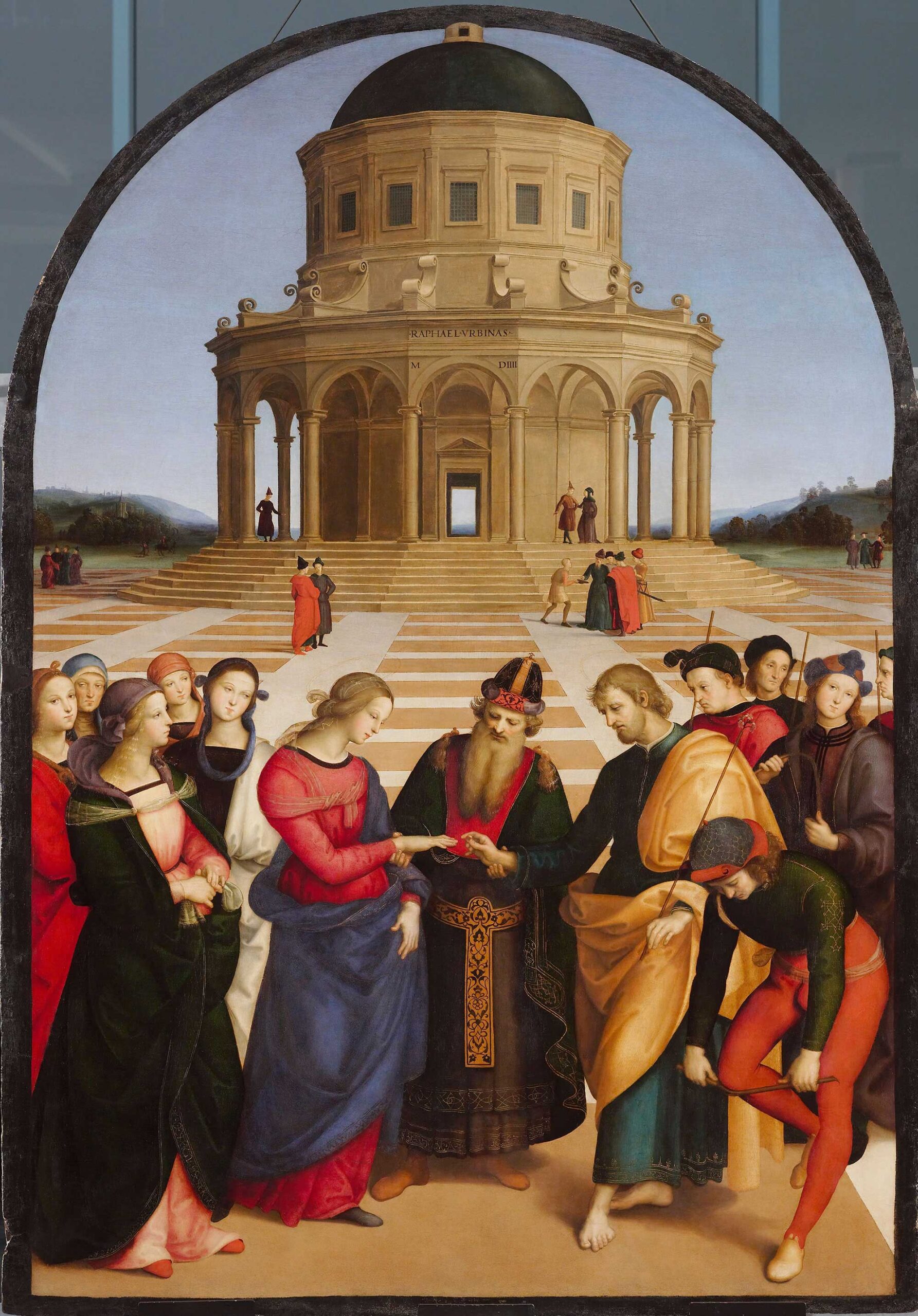
The somewhat complex painting that we are about to describe is Raphael’s Marriage of the Virgin. The altarpiece, an oil painting on wood dated 1504, is painted in a realistic style. The picture is rectangular in shape, taller than it is wide, and is round at the top. It is 118 centimetres wide and 170 centimetres high.The scene it depicts is the marriage of Mary and Joseph as described in the Apocryphal Gospels and the Golden Legend, a book containing stories of the lives of the saints. These sources tell us that the High Priest of Jerusalem, inspired by God, asked several suitors for Mary’s hand to come to the Temple with a withered branch. Joseph was chosen from among their number because his branch alone burst miraculously into flower when it was placed on the altar.The picture shows the moment when Mary and Joseph exchange wedding rings in the presence of the High Priest, five young girls and five suitors. The scene is set outdoors in daytime. The figures in the foreground take up the whole of the lower part of the painting. They are shown as full figures, standing, and we see them from a frontal viewpoint set slightly above ground level.
Behind them, in the centre of a broad square, a domed temple sits at the top of a short flight of steps. In the background, a distant hilly landscape lies beneath a clear sky occupying the upper part of the painting on either side of the temple. To make it easier to understand the painting, we should now try to imagine it split into 9 equal sections obtained by crossing three columns with three lines, like a noughts and crosses grid. We can number the sections using a telephone keypad layout from left to right: 1, 2, 3 above; 4, 5, 6 in the middle; and 7, 8, 9 below.We can start our examination of the painting with the section closest to us.
In the centre of the group of figures in the foreground we see the High Priest with his body in section 8 and his head in section 5. He separates the part of the painting with female figures in sections 4 and 7 from the part with male figures in sections 6 and 9. The priest, his head leaning to one side, joins the hands of the betrothed couple standing beside him, holding their wrists as he helps Joseph to place the ring on Mary’s finger. All three gaze at the ring, their expressions, like those of the other figures, serene and measured. Raphael has taken great care in depicting the details of their clothing. The High Priest wears an ornate cap on his short, grey-brown hair, and his long beard is split into two pointed tails. He is attired in a long purple tunic with an embroidered hem and with a gilded and decorated belt dropping
vertically in the shape of a cross at the front. He also wears a long, dark green mantle with embroidery at the hem and a red bib, while orange shoes peep out from beneath his robes.
Mary, to the priest’s right, turns towards the centre of the scene. Her light brown hair, partly caught up behind her neck, is covered by a very light, transparent veil falling to her shoulders and tied at the breast. She has a thin gold halo around her head. She wears a simple red gown, the collar edged in black, while a blue mantle falls softly away from her left shoulder. Her grey shoes peep out from beneath her gown.Joseph, to the priest’s left, also turns towards the middle of the scene. The oldest of the suitors in attendance, he has a beard and short, light brown hair, and he too, like Mary, has a thin gold halo around his head. A deep yellow mantle falls softly away from his left shoulder to reveal a bright green tunic, with the thin white line of his shirt collar visible at the neck. He is the only figure who is barefoot. In his left hand he holds the flowering branch that confirms his role as the chosen suitor.The scene in the lower foreground is completed by a number of secondary figures. Beside Mary we see a full-figure depiction of one of the five girls, holding a white linen handkerchief in her hands which are crossed over her belly, as she gazes at Mary. In section 4 we see the heads and busts of the other four girls with gowns of various colours and with their hair dressed in a variety of different styles.In sections 6 and 9 we see the five suitors. One of them stands beside Joseph and is shown bending forward in an attempt to snap his branch by placing it over his right knee and vigorously pulling the two ends towards him. The other four suitors are behind Joseph, in section 6, each one holding his withered branch.
In the middle ground, behind this large group of figures, we see the square in which the marriage is being celebrated. The square is paved with ochrecoloured panels separated by light stone strips that increase the perspective effect as they converge on the temple set atop the short flight of steps running all the way around it.Various figures are dotted about the large square in a balanced composition: two central groups are set before the steps and another two groups stand further back on either side of the temple while a single person
in section 4 and two in section 6 stand at the top of the steps.The centrally planned temple is light ochre in colour. It dominates the square, chiefly occupying sections 2 and 5. It is sixteen-sided and so at first sight it may seem almost circular. The ground floor is surrounded by an arched portico carried on thin columns; a door in the centre is perfectly
mirrored by another door at the back of the building, allowing us to see right through the building and catch a glimpse of the landscape behind it.The top floor has a series of rectangular windows and is topped by a smooth, dark green dome. The dome, in its turn, is crowned by a lantern reaching right up to the top of the painting. The natural landscape on either side of the temple consists of low hills in nuanced shades of green and blue. A clear sky dominates the upper part of the painting which ends, as we have seen, in a semicircular arch.Sunlight illuminates the entire scene with its warmth, coming from a source outside the picture at 2 o’clock and casting only short and fairly insignificant shadows. The luminous colours alternate in a perfect balance between cold and warm tones. And finally, we should note the signature RAPHAEL URBINAS, Raphael of Urbino, and the date of the work, MDIIII
(1504), in Roman numerals just below it, on the central arch of the portico surrounding the temple. The formal description, drafted in March 2019 was produced by the Pinacoteca di Brera’s Education Departmentin conjunction with the DescriVedendo team and with the not-for-profit Associazione Nazionale Subvedenti, thanks to the support of the Lions Clubs
International Milano Borromeo and Milano Duomo.
Art Historical Description
When Raphael painted this picture, he was about 20 years old and had already left his home town of Urbino, where he had picked up his first notions of art in his father’s workshop, to visit Perugia, Rome, Siena and Florence. Before returning to Florence to study the work of Leonardo and Michelangelo in greater depth, he completed a number of paintings in Città di Castello, the Umbrian town from which this altarpiece comes. It was commissioned from him by the Albizzini family for the Chapel of St. Joseph in the church of San Francesco.Raphael was probably asked to produce a picture similar to the one that Pietro Vannucci, known as Perugino, was painting for the chapel in Perugia cathedral erected to house the Holy Ring that was believed to have been placed on the Virgin’s finger at her marriage. Raphael certainly emulated Perugino’s subject matter and overall composition, with the most important figures in the foreground and a broad square opening out behind them and dominated by a temple in the background. But while the space in Perugino’s altarpiece is two-dimensional, Raphael’s great innovation lay in creating a space spreading out from the temple’s vertical axis to embrace the entire square and extend as far as the curve of the
horizon. He got the basic idea for this astonishing innovation both from the theories formulated by Leon Battista Alberti in his treatise entitled De Re Aedificatoria in which he extolls the circle as the perfect form of the elements in nature and describes the ideal church as white, centrally planned and built on a vast square but raised off the ground, and from those formulated by Piero della Francesca and Bramante who describe beauty as an order of geometrical and musical ratios capable of reawakening in the observer the harmonious sense of the Universe.The temple, set in full light and distanced by the gradually shrinking paving slabs with their precise perspective lines, is the source of this circular space. The figures in the foreground, who are not in a straight line but are arranged in a semicircle fanning out over the paving slabs, also help to reflect the circular rhythm dominating the whole composition. The figures are extremely controlled in their gazes and in their very basic
gestures and poses in order to ensure that everything converges and focuses on the priest’s ritual gesture and that nothing distracts the observer’s eye from the symbolic significance of the temple in the centre of the picture.In varying his figures’ features, costumes and poses, Raphael succeeds in conveying a feeling of immense simplicity and naturalness, to which the small figures in the distance linking the foreground to the temple and the landscape also contribute. The overall feeling of harmony is also expressed through a rich and skilfully measured palette.The altarpiece graced the altar in the Chapel of St. Joseph until 1798,
when Giuseppe Lechi, commanding a detachment of the Napoleonic army, took it with him to Brescia. He claimed that it was freely offered to him by the local people, but later reconstructions suggest that the troops forced the people to hand over the painting. After passing through several hands, it was finally bought by Giuseppe Bossi, the Secretary of
the Reale Accademia di Brera, in 1806 for the picture gallery that was still in its infancy at the time.
Biography
Raphael, the son of painter Giovanni Santi, was born in Urbino in 1483. Orphaned while still only a child, he worked at the court of the Montefeltro. Vasari lists him among Perugino’s pupils, but full light has yet to be shed on the relationship between the two. What we do know is that he was familiar with Perugino’s work when the latter was painting in Perugia and Città di Castello in the early years of the 16th century.Raphael came to full artistic maturity in Florence in late 1504, but for his unquestioned public acclamation he had to wait until he moved to Rome in 1508, where he began to work at the courts of Pope Julius II and Pope Leo X. Within a few years he was earning such important commissions as painting the frescoes in the Vatican Stanze, producing the cartoons for the tapestries in the Sistine Chapel and decorating the Vatican Logge and the Loggia of Psyche in Sienese banker Agostino Chigi’s Villa Farnesina. In later years he also intensified his study of the city’s classical monuments thanks to a commission from Leo X to produce a map of ancient Rome. He died in Rome on 6 April 1520.
05 - Christ and the Samaritan Woman by Annibale Carracci
Descrizione morfologica
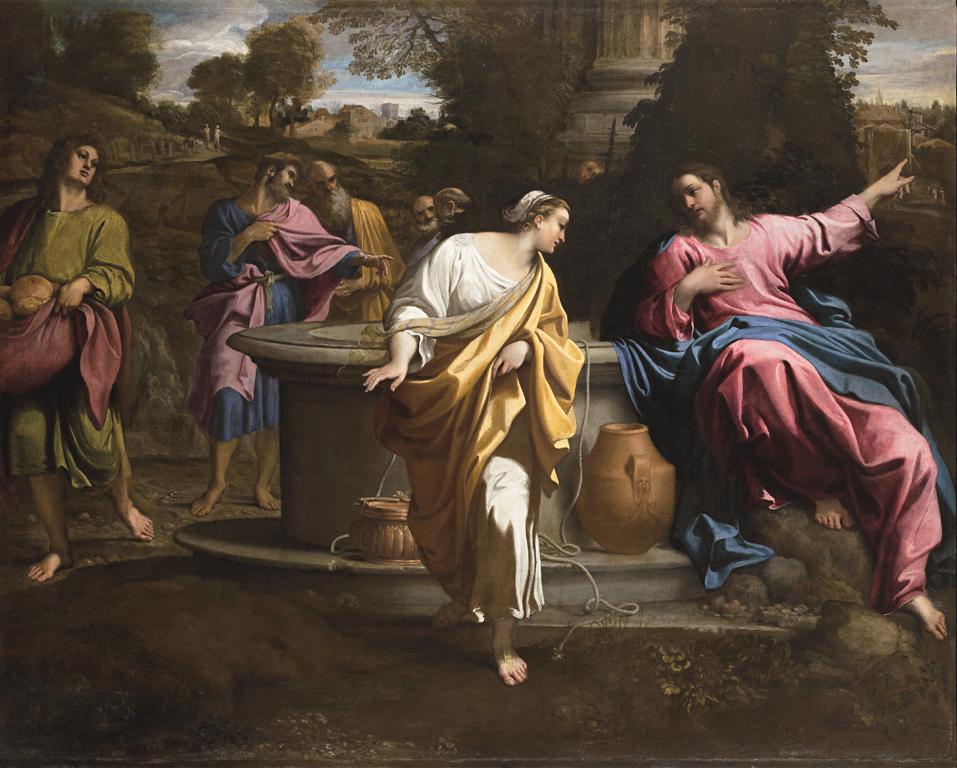
Cristo e la Samaritana al pozzo è un dipinto realizzato da Annibale Carracci fra il 1593 e il 1594. Le sue dimensioni sono di 170 centimetri di altezza per 225 centimetri di larghezza e si presenta quindi come un grande rettangolo con il lato maggiore in orizzontale. Si tratta di un olio su tela, dipinto in modo realistico: il pittore ha voluto cioè ritrarre i personaggi e il paesaggio con forme e colori come li può percepire l’occhio umano. Il quadro fa riferimento a un episodio del Vangelo di Giovanni, in cui si racconta dell’incontro, in prossimità di un pozzo, fra Gesù e una donna della Samaria; ad essa Gesù spiega la differenza fra la fede, che disseta per sempre, e l’acqua del pozzo, che può dissetare solo temporaneamente. Il soggetto del quadro raffigura quindi, in primo piano, Gesù mentre parla alla Samaritana vicino a un pozzo presso cui la donna si è recata; in secondo piano, alcuni discepoli osservano incuriositi la scena o la commentano tra di loro. L’ambientazione è in luce diurna in un paesaggio naturale con scarni elementi architettonici e uno sfondo collinare con centri abitati in lontananza. Il punto di vista adottato dal pittore è frontale rispetto alla scena e i personaggi principali sono ritratti a figura intera. Per descrivere meglio l’opera, proviamo ora a immaginarla suddivisa in 9 settori di uguali dimensioni, ottenuti incrociando tre colonne e tre righe. A ogni settore, per convenzione, diamo la numerazione usata nelle tastiere telefoniche. Da sinistra a destra: 1, 2, 3 nella fascia superiore; 4, 5, 6 nella fascia centrale; 7, 8, 9 nella fascia inferiore. Descriveremo dapprima ciò che risulta più prossimo all’osservatore, per poi proseguire con quanto risulta via via più distante, fino agli elementi di sfondo. La Samaritana è la figura in primo piano, in piedi al centro del dipinto, nella parte inferiore del settore 2 e nei settori 5 e 8. È una giovane donna, con il corpo rivolto verso lo spettatore ma la testa girata verso Gesù, che si trova nella parte destra della tela: sembra intenta ad ascoltarlo, quasi assorta, tenendo lo sguardo rivolto verso terra. Il volto, che ci mostra il profilo destro, ha lineamenti regolari e un incarnato chiaro con un leggero arrossamento sulla guancia. Ha i capelli morbidamente raccolti in un panno bianco avvolto dietro alla testa. La donna, di aspetto florido, indossa una lunga tunica bianca e un mantello giallo oro, che dalla sua spalla sinistra si appoggia morbido sul braccio. Il mantello ricade sul bacino fino alle gambe, trattenuto dalla mano sinistra , come per evitare di inciampare nel lungo tessuto. Più sotto sporgono i piedi nudi, tenuti uno davanti all’altro; un piede tocca già il terreno alla base dei gradini. La donna, infatti, ha quasi disceso i due gradini del pozzo e sembra fermarsi improvvisamente, trattenuta dalle parole dell’uomo. Gesù occupa la parte inferiore del settore 3 e i settori 6 e 9 del dipinto e per chi osserva risulta di poco arretrato rispetto alla Samaritana. È seduto frontalmente su un cumulo di rocce che è addossato al pozzo e che ricade in parte sui due gradini anteriori. È rappresentato come un giovane uomo, con i capelli lunghi castani e un accenno di barba sul volto; ha il capo e lo sguardo rivolti verso la Samaritana e tiene la bocca chiusa: assume così un’espressione dolce, ma anche ferma, propria di chi sa essere autorevole. Tiene il braccio destro piegato, con il gomito appoggiato sul bordo anteriore del pozzo e la mano aperta sul petto. Con il braccio sinistro compie un gesto ampio: lo tiene disteso di lato e leggermente indietro e in alto, verso la parte destra del dipinto; l’indice è puntato, come a mostrare qualcosa di lontano. Le gambe sono discoste fra loro e i piedi nudi poggiano sulle rocce ad altezze diverse: il piede destro è più in alto e il ginocchio raggiunge l’altezza del bordo del pozzo, mentre il piede sinistro è più in basso e la gamba così resta più distesa. Veste una lunga tunica di un rosa intenso e un manto blu, posato morbidamente di traverso sulle gambe. Sempre in primo piano, dietro la Samaritana e Gesù, c’è il pozzo circolare in pietra, che sorge su un basamento rialzato di due gradini rispetto al suolo. Sul basamento, appoggiati alla parete del pozzo, troviamo un secchio panciuto con scanalature verticali – a sinistra della Samaritana per chi guarda – e un’anfora – tra la Samaritana e Gesù – vicino alla quale una corda scende fino a toccare il suolo, di fianco al piede sinistro della donna. In secondo piano sono raffigurati cinque discepoli, appena tornati da un villaggio dove erano andati a fare provvista di cibo. Uno di essi, raffigurato al limite del dipinto, nel settore 1 e 4 e più vicino alla scena in primo piano, è un giovane che rivolge uno sguardo rispettoso e al contempo incuriosito all’inatteso discorso che Gesù sta facendo alla donna. È vestito con una tunica verde al polpaccio e un mantello rosso, che solleva per contenere alcune pagnotte. Tra i settori 1, 4 e 2, 5, dietro al pozzo, sono raffigurati altri due discepoli più attempati che parlano fra loro; uno dei due indica Gesù e la Samaritana. Un po’ più arretrata è un’altra coppia di discepoli, che parlano anch’essi fra di loro e di cui vediamo solo le teste nel settore 2. Nella scena ha una parte molto importante il paesaggio. Dietro al pozzo, sono visibili la parte inferiore di una colonna antica e alcuni alti cespugli scuri, che fanno da sfondo alle due figure principali. Nel settore 3, dietro il braccio e la mano di Gesù che sembra indicare un punto lontano, si scorge la porta di accesso a un altro abitato. Più in lontananza, in corrispondenza del settore 2, sotto un sottile squarcio di cielo azzurro venato da nuvole, è visibile su un’altura il profilo di una città fortificata, con le mura e una torre. Nel settore 1 un sentiero, su cui camminano due figure appena abbozzate, sale sulla collina, che inizia dietro ai discepoli, e si inoltra tra alcuni alberi. La luce proviene dall’alto a destra del dipinto ed è più intensa sulla scena in primo piano dove si trovano Gesù e la Samaritana, il pozzo, l’anfora e il secchio. In questa zona il contrasto tra luce e ombra è molto deciso: il volto di Gesù per metà è in ombra, così come il mantello della Samaritana; il volto della Samaritana e la parte alta della sua tunica bianca sono in piena luce; le ombre portate dell’anfora sul pozzo e del pozzo stesso sul gradino a sinistra sono marcate. L’intensità della luce va diminuendo man mano che ci si allontana dal primo piano. Nell’insieme, il paesaggio collinare è dominato dai toni del grigio-marrone e del verde scuro, mentre il cielo nuvoloso ha squarci di azzurro. Su questo sfondo, si distinguono gli abiti colorati dei personaggi, più brillanti, perché maggiormente illuminati, quelli di Gesù e della Samaritana, meno intensi quelli dei discepoli.
Descrizione storico-artistica
Cristo e la samaritana al pozzo è un dipinto di Annibale Carracci, proveniente da Palazzo Sampieri di Strada Maggiore a Bologna. Giunse a Brera nel 1811, insieme ad altre opere della rinomata collezione lì custodita, vendute dai Sampieri in difficoltà economiche.
La tela di Annibale fu concepita insieme a Cristo e l’adultera di Agostino Carracci e a Cristo e la cananea di Ludovico Carracci, esposta in questa stessa sala. I dipinti erano stati realizzati dai Carracci in una sorta di gara pittorica e costituivano l’ultima impresa collettiva dei tre a Bologna. Le tele Sampieri erano citate nelle fonti antiche come sovrapporte, cioè dipinti che decoravano la porzione di parete sopra l’apertura delle porte. Queste opere con storie evangeliche erano accostate agli affreschi con le imprese di Ercole, anch’essi realizzati dai Carracci: le prime erano poste più in alto dei secondi sulle pareti. Il tema della virtù che aiuta a resistere alle avversità della vita accomunava i temi sacri e quelli profani.
Fu l’abate Astorre Sampieri a commissionare quest’ultima impresa compiuta insieme dai Carracci, realizzata prima del 1595, quando Annibale partì per Roma. I Carracci erano allora tra i più apprezzati artisti a Bologna.
L’episodio raffigurato si ispira al Vangelo. L’evangelista Giovanni (4, 1 – 42) infatti, narra che, nel tornare dalla Giudea verso la Galilea, Gesù giunse in Samaria, nei dintorni della città di Sichar. Mentre i suoi discepoli andavano a cercare del cibo in città, Gesù, sedutosi presso il pozzo di Giacobbe, chiese da bere a una donna samaritana. La donna apparve sorpresa dalla richiesta, dato che tra il popolo giudeo e quello della Samaria non intercorrevano buoni rapporti. A quel punto Gesù le rivelò quale fosse la sorgente d’acqua viva ed eterna, cioè Dio.
Nel quadro, Gesù, grazie a una gestualità chiara e sobria, indica sé stesso come Messia e invita la donna della Samaria a farsi messaggera presso la vicina città. Gesù ha una veste rosa intenso e un manto blu; gli stessi colori sono invertiti negli abiti del discepolo che discute con altri, in secondo piano. La Samaritana è figura dinamica, ritratta nell’atto di mettersi in movimento, ed è investita dalla luce di Gesù. Un giovane a sinistra, forse l’evangelista Giovanni, reca con sé le forme di pane che si era procurato assieme agli altri discepoli in città.
Si sottolinea che nel restauro del 2011 è stata recuperata la cornice a foglia d’oro, rivelatasi l’originale di casa Sampieri.
Biografia
Annibale Carracci (Bologna 1560 – Roma 1609) fu un artista fondamentale per il rinnovamento della pittura tra la fine del Cinquecento e l’apertura del Seicento. Esordì a Bologna, dove si era trasferito il padre, di origini lombarde, ma raggiunse grande fama a Roma, dove arrivò a trentacinque anni, come pittore già affermato.
Nel 1582, Annibale, suo fratello Agostino e il cugino Ludovico aprirono una bottega di pittura chiamata dapprima “Accademia del Naturale” e poi “degli Incamminati”: una scuola basata sulla pratica del disegno più che su principi teorici. Nell’Accademia, maestri e allievi si dedicavano a disegnare il più possibile e copiavano sia le opere dei grandi artisti del passato, come Raffaello, che i modelli reali, le persone che frequentavano il loro studio. I Carracci – e i pittori emiliani con loro – imitavano la natura come Caravaggio, ma ne selezionavano solo gli aspetti migliori grazie allo studio delle antichità classiche, dei maestri del Rinascimento e dei testi letterari.
Le numerose pale d’altare di Annibale e di Ludovico interpretarono alla perfezione la necessità, dopo il concilio di Trento, di ridare senso e forza alla rappresentazione delle storie sacre per renderle più vive, naturali e vicine all’umanità. La stagione dell’arte manierista, macchinosa e innaturale, poté, con loro, dirsi conclusa.
È difficile distinguere i contributi individuali dei Carracci nei primi lavori: ad esempio gli affreschi di Palazzo Ghisilardi Fava a Bologna – raffiguranti scene della vita di Giasone – portano la firma “Carracci”, ad indicare il contributo collettivo. Nel 1587-1588, Annibale visitò Venezia e Parma: fondamentale fu per lui l’uso del colore tipico della pittura veneta e la grazia del pittore parmense Correggio. Annibale riuscì a fondere queste caratteristiche con l’importanza del disegno, che rimase comunque un caposaldo della sua pratica pittorica. Tra il 1589 e il 1592, i tre Carracci completarono gli affreschi raffiguranti la Fondazione di Roma per Palazzo Magnani a Bologna. Intorno al 1593-1594, lavorarono insieme agli affreschi di Palazzo Sampieri, sempre a Bologna, da cui proviene il quadro con Cristo e la samaritana al pozzo. La fama di tali affreschi, tra i maggiori esempi di pittura emiliana del tardo Cinquecento, procurò ad Annibale l’invito del cardinale Odoardo Farnese per la decorazione di Palazzo Farnese a Roma. Per il cardinale dipinse la volta del cosiddetto camerino, ovvero la camera da letto, con Storie di Ercole e quella, con Gli amori degli dei, del salone d’onore destinato ad accogliere una parte della collezione farnesiana di sculture antiche.
Annibale fu anche un innovatore nel campo della pittura di paesaggio: come visibile già sullo sfondo del quadro della Samaritana, la natura idealizzata assunse un ruolo via via più importante nella composizione dei dipinti. Nelle cosiddette “Lunette Aldobrandini”, dipinte a Roma nel primo decennio del Seicento, l’uomo, l’ambiente e gli edifici si fondevano con grande armonia, contribuendo alla creazione del prototipo del “paesaggio ideale”. Tale fu la fama di Annibale che è sepolto nel Pantheon a Roma, vicino alla tomba di Raffaello.
Transition
In mezzo alla sala, si trova un banchetto con una sedia, che ospita un bassorilievo della Cena in Emmaus di Caravaggio, a una distanza di circa 12/13 passi dall’opera. Si tratta di una traduzione tridimensionale in resina del capolavoro di Caravaggio, pensata in modo particolare per il pubblico cieco e ipovedente, che può però rendere la fruizione più coinvolgente per tutti. Oltre al bassorilievo, il banchetto ospita anche i dati essenziali del quadro, in caratteri grandi e in braille, e il QR code che rimanda allo stesso audio DescriVedendo contenuto in questa audioguida. In fondo alla sala, sulla parete opposta rispetto a dove sei entrato, tra le due aperture ad arco si trova appunto la Cena in Emmaus di Caravaggio.
06 - The Supper at Emmaus by Caravaggio
Formal Description
The episode on which the picture is based is recounted in the Gospel of St. Luke. A few days after Jesus was crucified, two of his disciples were walking towards Emmaus, a village just outside Jerusalem, when they met a man who joined in their conversation about the recent event. In the evening the three men stopped at an inn and there, as they were dining,
the unknown traveller blessed and broke the bread. In his traditional, extremely realistic style, Caravaggio captures on his canvas the precise moment in which Christ blesses the bread and the two astonished disciples recognise him, before he disappears.
The picture we are about to examine is a rectangular oil painting on canvas, its horizontal side somewhat longer than the vertical. It is 175 cmwide and 141 cm high, and the figures depicted are almost life-size.In the painting, we see Jesus and his two disciples seated at a table with an innkeeper and a servant standing just behind them. The scene is set in an inn, although we cannot see the inn because the background from which the figures emerge is shrouded in darkness. Only the figures and the table are illuminated, and they occupy the lower right-hand part of the painting. Caravaggio has chosen a frontal viewpoint. We observe the scene from close up and see both the sitting and the standing figures from the waist up. To glean further details from the painting, we should now try to imagine it split into 9 equal sections obtained by crossing three columns with three lines, like a noughts and crosses grid. We can number the sections using a telephone keypad layout from left to right: 1, 2, 3
above; 4, 5, 6 in the middle; and 7, 8, 9 below. Let us begin our examination with sections 7, 8 and 9, in which we see a rectangular table running parallel to the lower edge of the picture. The table has a carpet draped over it and the carpet is covered, in its turn by a white tablecloth on which we see the shadows cast by the handful of items on it: from left to right, a loaf of bread and a ceramic plate containing leaf vegetables. Behind the plate we see a second loaf of bread which has already been broken. Further to the right, an empty
pewter plate and a ceramic jug partly conceal of glass of red wine.Now let us consider the human figures, starting with those closest to our us and moving backwards. In sections 4 and 7, on this side of the table, a seated disciple turns his back to us. He wears a brown tunic under a light-coloured cloak. His hair is curly and his open arms are very slightly outstretched towards Jesus in a gesture of sudden understanding and surprise. In sections 6 and 9, another disciple shown in profile is seated at the short side of the table. He wears a brown tunic beneath a cream mantle. He has short hair, a beard and moustache, and a swarthy complexion. His forehead is creased in astonishment as he leans towards Jesus, while his arms grip the edge of the table as though he were about to rise. In section 5, Jesus, the main figure in the scene, is seated at the long side of the table opposite us and slightly to the left. He, too, wears a tunic but his mantle is dark green. The light only hits one side of his pale face, which stands out against the dark background. He wears a short beard
and his dark, wavy hair falls to his shoulders. He is looking down, his right hand raised and his fingers suggesting that he is about to bless the bread in front of him, while his left hand rests on the table.In sections 2 and 5, the innkeeper stands behind Jesus and immediately
to his right. He wears a small white cloth cap, an open-collared white shirt and a darker overshirt unbuttoned to halfway down his chest. He is no longer young, and his rubicund face is surmounted by a broad, lined forehead. He observes Jesus blessing, his head lowered, his chin touching his neck and his left fist clenched with his thumb hooked in his belt.In sections 3 and 6, beside the innkeeper, we see an ageing servant in modest working attire sporting a white cap over her dark hair, which is tied back in a bun. Her face is as lined as the innkeeper’s. She is the only figure not looking at Jesus: her gaze is lowered, as though she were daydreaming, and she holds a platter of meat in her hands. The whole scene is lit by warm light from an invisible source situated at 10 o’clock. The figures around the table appear to be emerging from a murky, unfathomable background that sets off their silhouettes, breathing life into the figures and making them almost tangible. The painter’s palette is played out in a myriad different shades of brown and earthen colours. The formal description, drafted in February 2018 and certified by Describing and Seeing, was produced by the Pinacoteca di Brera’s Education Service in conjunction with the DescriVedendo team and with the not-for-profit Associazione Nazionale Subvedenti, thanks to the support of Diadromi percorsi senza confini.
Art Historical Description
The moment that Caravaggio has chosen to depict in his Supper at Emmaus is the key moment in an episode from the Gospel of St. Luke in which two disciples realise, when he blesses the bread, that the pilgrim who has travelled with them to Emmaus and whom they have invited to dine with them is in fact the risen Christ. In 1602 Caravaggio produced another version of the Supper at Emmauswhich is now in the National Gallery in London. Despite the subject matter and the overall approach evinced in the two paintings being
extremely similar, they also display profound differences. The London painting’s luminous composition is rich in descriptive elements, while the second version’s intimate, more meditative tone is the result of its dark setting and of the mere handful of items depicted in it: the broken bread, a jug and two simple plates replace the sumptuous still life in the youthful
version. The Brera Chist also has a thin, weary face, bearing very little resemblance to the beardless youth in the earlier version. In both cases, the presence of poor, shabby figures not only echoes the Lombard artistic tradition in which Caravaggio trained but it also reveals
the artist’s interest in the lower social classes. He chose his models from those classes as well as the settings for his works, in which God’s presence is made manifest by his unique handling of light. In the Brera Supper, the light comes from the left, causing the figures in the
foreground to emerge from the darkness, it dwells on certain details such as the folds in the tablecloth or the reflections on the jug and it highlights the figures’ gestures and faces, thus imbuing the scene with greater emotional and psychological intensity. The two pictures were painted only a few years apart, yet a major change occurred in Caravaggio’s style in the intervening years. It became starker both in terms of his palette which tended almost towards a monochrome effect, and of his compositions with fewer figures and fewer items yet with a greater focus on expressive content. His technique, typical of his mature work, is made up of rapid brushstrokes that allow the primer layer to show through in certain areas, while the marks incised on the fresh primer point to his use of models from life.The dramatic tone of the second version may be the result of a troubled moment in Caravaggio’s life that began with a tragic episode. One of the painter’s adversaries was slain in a fight on 29 May 1606. Caravaggio was charged with murder and so, to escape the death penalty, he fled Rome and sought refuge in Zagarolo, a guest on the estate of the princely Colonna family. This was where he painted the second Supper at Emmaus, which he immediately offered for sale so that he could pursue his journey to Naples. The picture was later sent to Rome, where it was bought by the aristocratic Patrizi family who hung it in their family palazzo in the heart of the city, and there it remained until 1939 when Director Ettore Modigliani proposed that the government purchase it for the Pinacoteca di Brera.
Biography
Michelangelo Merisi, known as Caravaggio after the name of the village his family came from, was born in Milan in 1571. He moved to Rome in c.1592 to paint with the Cavalier d’Arpino, who was struck by his ability “to paint flowers and fruit.” Caravaggio’s youthful paintings tend to focus on poetic and elegiac themes, with the allegorical and religious compositions of such paintings as the Rest on the Flight into Egypt, the Penitent Magdalen, Bacchus, a Boy with a Basket of Fruit and the Basket of Fruit(the other Caravaggio painting now in Milan). Under the protection of Cardinal Francesco Maria del Monte and of Marquis Vincenzo Giustiniani, Caravaggio was commissioned in 1599 to decorate the Contarelli Chapel in the church of San Luigi dei Francesci with Stories from the Life of St. Matthew, his first public work, which was to set him on the path to fame despite a controversy and a scandal blowing up around it.Caravaggio went on to produce a series of very important works including the Crucifixion of Saint Peter and the Conversion of St. Paul for the Cerasi
Chapel in the church of Santa Maria del popolo, and the first version of the Supper at Emmaus. Forced to flee Rome after killing his sparring partner in a duel in 1606, he spent a short time in Zagarolo, on the countryside on the outskirts of the city, before moving down to Naples. From there he travelled to Malta and to Sicily before returning again to Naples. Setting out from that city, he attempted to return to Rome with a view to being granted a papal pardon and landed at Porto Ercole, where died, alone and unwell, in 1610.
07 - Errand Boy Seated with a Basket on His Back, Eggs and Poultry by Giacomo Ceruti (Pitocchetto)
“Errand Boy Seated with a Basket on His Back, Eggs and Poultry” is the title of this work by Giacomo Ceruti known as il Pitocchetto, painted between approximately 1730 and 1735. The painting measures 130 centimetres high by 95 centimetres wide and is therefore presented as a rectangle with the longest side vertical. It is an oil on canvas, painted in a realistic manner: that is, the use of shapes and colours tends to reproduce in detail what the human eye perceives.
In an unrecognisable setting, the painting depicts a modest-looking boy who is a ‘porter’, i.e. he earns his living by carrying what can be contained in a large wicker basket. He is seated on a stone, dressed in humble clothes, with his basket, empty at the moment, slung over his shoulder, the handle slung over his shoulders, and holding a live cock and hen and a basket of eggs in his hands. The painter portrays him full-length from a close distance, standing at his height. The boy is seated almost in profile, facing to the left of the canvas; his face, on the other hand, is turned three-quarters and looks towards the spectator.
To better understand the position of the various elements in the work, let us now try to imagine it divided into 9 sectors of equal size, obtained by crossing three columns and three rows. To each sector, by convention, we give the numbering used in telephone keypads. From left to right: 1, 2, 3 at the top; 4, 5, 6 in the middle; 7, 8, 9 at the bottom.
The face occupies sector 2. The porter has the features of a young boy: under a black woollen cap he shows in three-quarter view mainly the left side of a face with still childlike features. In it, the eyes stand out, large and dark, intensely looking at us. A few wisps of brown hair come out haphazardly on the left side from under the cap, which covers a good part of the ear; the forehead is partly covered by the headgear and ends with two straight, thin eyebrows; the rounded nose and smooth cheeks seem barely flushed; the closed mouth shows full, deep pink lips. The face conveys a sad and fatigued air, like the figure as a whole.
The boy’s torso occupies section 5. He appears slightly reclined backwards, leaning against the large, tall basket he carries on his shoulders. He wears a frayed shirt of a dull white, held open at the front and over it passes diagonally, from the right shoulder to the left arm, the wicker strap of the large basket carried behind. The left arm is stretched along the side, covered by the sleeve of the shirt up to the middle of the forearm. In section 8, the boy comes to rest his left hand on the stone, on which he is sitting, bending his fingers as if to follow its edge. The right arm, which is less visible, is also held along the torso, from the shoulder to the hip. In section 5, the forearm then bends towards the legs of the seated boy and passes through the arched handle of a small basket, visible next to the right leg; the basket is tilted towards the viewer, so as to show the eggs it contains. The right hand, on the other hand, grasps the legs of a white hen and a black rooster, lying on its haunches; of the two animals the heads with their beaks, crests and red wattles are clearly visible, close to the left edge of the canvas, between sectors 4 and 7. Also in sector 7, the boy’s legs, which are held horizontally up to the knees to support the poultry, continue downwards: the right one comes to rest the entire sole of the foot on the ground, while the left one crosses behind the right ankle and thus hides the view of the left foot behind the stone. The porter wears simple brown trousers that he keeps tucked in at calf height, while his feet are bare. The right side of the canvas, in sections 3, 6 and partly 9, is occupied by the large, low, wide, woven wicker carrying basket, which is now empty and which the boy carries over his shoulder, with the large handle, also made of wicker, slung over his shoulders and the longer sides of the basket parallel to his back. In this position the basket, resting on the stone where the boy is sitting, exceeds his head in height.
The porter is seated on two juxtaposed stones, in sectors 8 and 9, next to which are smaller, irregular stones resting on a strip of ground. In the background, at a short distance from the subject in the foreground, is a wall composed of large stone blocks, which fills mainly on the left sectors 1 and 4, and partly 2 and 3, above the head of the porter. The light comes from an unseen source placed high up and slightly to the right, which frontally illuminates the boy’s face placed in three quarters, but also his body, poultry and eggs. On the wall to the left, in section 4 and part 7, the large shadow cast by the basket he is carrying is evident. The painting has a brown dominant: the boy’s trousers, the large basket and the small one with the eggs, the stones, the floor, the wall. Some objects have a greater sheen, such as the woven wicker baskets, but in general earthy, dull tones prevail. Among the lighter hues, the shirt is opaque and off-white. A lighter white is instead that of the eggs and the hen’s plumage: the light falling on these elements makes them stand out more. In this context of mostly muted colours, matching each other, the bright red of the poultry’s crests and wattles stands out in contrast.
08 - The Kiss by Francesco Hayez
Formal Description
The painting’s full title is The Kiss. An Episode of Youth. Costumes of the14th Century, but it is more commonly known as just The Kiss. It waspainted by Francesco Hayez in 1859.
It is a rectangular oil painting on canvas, the longer side being the vertical one, and it measures 112 cm in height by 88 cm in width. The subject matter is fairly simple: the painting provides a realistic depiction of a young man and a young woman passionately embracing as they kiss each other on the lips. The two figures, elegantly clad in medieval attire, are in an empty space inside a period building. The viewpoint is from the front, with the two lovers portrayed full-figure and approximately half life-size. To get a clearer idea of the painting, we should try to imagine it split into nine equal sections obtained by crossing three vertical columns with three horizontal lines. For the sake of convenience, we can number each sector like the keypad on a phone from left to right: 1, 2, 3 at the top; 4,
5, 6 in the middle; and 7, 8, 9 at the bottom. Let us begin our description with the central sections, 5 and 8 (and 2, in part) which is where the two young lovers are situated in the painting. They are standing one in front of the other: the girl in the foreground with her back towards us is almost enveloped by the boy who, on the contrary, is facing us. The boy is taller and has to lean down to kiss his beloved, gently holding her head in his hands, lifting her face with his right hand while holding her neck with his left. His right leg is planted firmly on the ground, while his left leg is bent and his left foot rests on the first of three steps rising into what we’ve called section 9 of the painting. The young girl in her lover’s arms arches her back to meet his face as he leans forward, gripping his shoulder with her left hand. To kiss him, she turns almost imperceptibly towards us, showing us the left-hand silhouette of her body and the outline of her face. The painter has taken meticulous care in depicting their medieval costume. The boy wears a pointed, taupe-coloured cap with dark feathers on one
side, his long, frizzy brown hair emerging from beneath it and his face almost totally concealed by it. His full brown cloak reaches almost to his knees and, in slipping off his right shoulder, allows us to see part of his dark green doublet beneath. We can just make out a dagger tucked into his belt beneath the open cloak. A pair of red hose and brown leather shoes complete his attire. The girl has long brown hair, parted in the middle in a loose style allowing it to fall softly down to her shoulders. She wears a long, sky-blue gown with a tight bodice, tight sleeves and full skirts falling to the floor, its sheen suggesting that it is made of silk satin. Beneath her gown we can see a white chemise peeping out at collar and cuff and pulled out to form a voluminous puff at the elbow. The cuff and collar of the gown are decorated with gold embroidery and she wears a thin gold belt around her waist. A wall made of light-coloured blocks of squared stone provides the backdrop to the scene, particularly in sectors 2, 3 and 6, while the floor is laid with brick-coloured terracotta tiles in a herringbone pattern and occupies sectors 7 and 8, breaking off in sector 9 where we find three large, light-coloured stone steps leading up to an unspecified area outside the picture. A tall, thin engaged column on the stone wall in sectors 1 and 4 frames an opening leading into a fairly dark space. We can only see part of the arch leading into it, the rest of the arch being outside the picture. Beyond the opening with its pointed arch in sector 4, another weakly lit space opens up to reveal a barely perceptible backlit human figure going
down to the floor below. Apart from this dark area on the left, the scene is brightly lit, the light
coming from a source outside the painting at 10 o’clock. The light strikes the girl’s left side especially strongly, creating reflections that are almost white in the folds of her sky-blue satin gown and casting the two young lovers’ strong shadow onto the staircase and the right-hand side of the painting. The bright colours used for the two lovers’ costumes, bathed in light, stand out sharply against the starkly neutral background. The formal description, certified by DescriVedendo, was produced by the Pinacoteca di Brera’s Education Service in conjunction with the DescriVedendo team and with the not-for-profit Associazione Nazionale Subvedenti, thanks to the support of the Lions Clubs International Milano Borromeo and Milano Duomo.
Art Historical Description
This painting, which has proven extremely popular with the critics and the general public even since it was first shown at the Accademia di Brera’s annual exhibition, is as celebrated today as it was back then; in fact it has become one of the Pinacoteca’s best-known works and one of the most famous pictures in the whole of Italian 19th century art. There are
numerous versions of The Kiss, the subject having proven instantly successful and allowing Francesco Hayez to replicate it many times over. Brera holds the first version, donated by Alfonso Maria Visconti di Saliceto who commissioned the picture, which was painted in 1859. In that year the troops of Vittorio Emanuele II, King of Sardinia and later Italy’s first King, allied with the French Army led by Napoleon III, defeated the Austro-Hungarian Army in the Second War of Independence and victoriously entered the city of Milan. The liberation of Lombardy and the Veneto from the foreign yoke paved the way for the unification of Italy,
which was proclaimed in 1861. Despite its subject matter associated with love, we should view the picture in the context of what is known as Historical Romanticism, a style which Hayez championed in Italy. In The Kiss, the depiction of an episode from history or literature set in the past has become an allegory of the present and an expression of values closely associated with the Risorgimento (as Italy’s unification movement is known) when civic
engagement and love of country prevailed over personal sentiment. For all its medieval setting and costumes, the scene conjures up a picture of a patriotic volunteer taking his leave of his loved one. Hayez, who joined other artists in using his art to testify to the
Risorgimento struggle, celebrates here the expectations and enthusiasm of his own day. The concepts of hope and a strong civic sense are expressed in this picture in an image whose very conciseness makes it hugely effective. The two figures’ half-concealed faces and the presence of only a handful of other elements cause us to focus all our attention on the action taking place, which consists of gestures as natural as they are riveting and passionate. The secret of the power in this painting, which has become something of an icon, probably lies in its depicting a kiss with such immediacy that it has become a timeless image.
Biography
Born in Venice in 1791, Francesco Hayez attended the Academy of Fine Arts in the city before going on to complete his studies in Rome under great Neoclassical sculptor Antonio Canova’s protective wing. On the strength of the experience that he built up amid ancient Classical sculpture and in Raphael’s Stanze in the Vatican, he moved to Milan where he was to spend most of the rest of his working life. He immediately began to frequent the city’s intellectual circles comprising fervent supporters of the Risorgimento movement, and indeed he himself became one of the chief exponents of that movement along with Verdi and Manzoni, to the point where Giuseppe Mazzini dubbed him the “nation’s painter bard”. While in Milan he trained future generations of artists, being appointed to the prestigious post of Professor at the Accademia di Brera in 1850. A highly skilled portrait artist and a tireless draughtsman, he died in 1882 at the age of 91. The Kiss, a mature work, contains a number of features that are typical of his painting, for example its stage-like composition and the unimpeachable elegance of his draughtsmanship. His sensitive handling of light and colour, a legacy of his Venetian birth and a product of his lengthy study of the work of Titian and Giorgione, is seen at its absolute best in the girl’s sky-blue satin gown. Reflecting a ploy much affected by Hayez, the neutral tones of the background and the diffused light skilfully modulated in space serve to highlight the bright colours of the figures in the foreground, which also have a symbolic significance: the girl’s blue gown and the boy’s red hose and green doublet allude to the union of the two tricolour flags of Italy and France.
Benvenuto / benvenuta!
Questo percorso attraverso otto capolavori della Pinacoteca di Brera è espressamente concepito per chi vede poco o non vede, ma è fortemente consigliato anche a chi vede bene. Ogni dipinto infatti viene illustrato da un’accurata descrizione morfologica – cioè da un racconto molto dettagliato di ciò che vi è raffigurato – seguita da una breve spiegazione storico artistica e da interessanti note sulla vita del pittore. In questo modo, indipendentemente dalla tua capacità visiva, potrai entrare in contatto anche con quei dettagli che a un primo sguardo non risultano immediatamente percepibili, in una scoperta lenta e graduale dei dipinti più celebri, una sorta di slow art.
Iniziamo dunque il percorso. La Pinacoteca di Brera si trova in via Brera 28. Superato l’ampio androne d’ingresso, lungo circa 7 metri, si accede al porticato che circonda il cortile centrale, di forma rettangolare e che misura circa 40 x 29 metri, rispetto al quale è rialzato di un gradino. L’ingresso del Museo si trova al primo piano, sul lato opposto rispetto all’ingresso dell’edificio appena attraversato. Per raggiungerlo ci sono due possibilità: si può rimanere sotto il porticato e percorrerlo fino ad arrivare a metà del lato opposto, oppure attraversare direttamente il cortile, al cui centro si trova la statua in bronzo di Napoleone in veste di Marte pacificatore di Antonio Canova; il suo piedistallo misura circa 2 metri x 2 e si può aggirare da entrambi i lati. Nell’angolo del cortile in fondo a sinistra rispetto al portone d’ingresso si trova il bookshop.
Attenzione: fino al 2028 saranno in corso lavori di rifacimento dei tetti e saranno dunque presenti dei ponteggi. Anche se in alcuni periodi sarà possibile attraversare per intero il cortile, fino al termine dei lavori, consigliamo di raggiungere gli scaloni rimanendo sotto al porticato e dirigendosi a destra o sinistra dopo l’androne d’ingresso, a seconda di quale lato del porticato sarà lasciato libero.
Arrivati sul lato opposto del cortile, ci si trova in un ampio corridoio, che a destra e a sinistra ha due scaloni per raggiungere il primo piano, in pietra grigio-rossiccia, larghi circa 3 metri e mezzo, con gradini di 13 cm di altezza e 40 cm circa di profondità senza marcagradino. La prima rampa conta 34 gradini e, dopo un grande pianerottolo con pavimentazione in pietra grigio scuro e una svolta di 180°, la seconda rampa ne conta 31. Nello scalone di destra, il corrimano si trova a sinistra nella prima rampa e a destra nella seconda; dal lato opposto c’è una balaustra. Nello scalone di sinistra, il corrimano è a destra nella prima rampa e a sinistra nella seconda.
In cima agli scaloni – alla tua destra o alla tua sinistra, a seconda di come ci sarai arrivato – c’è la porta d’ingresso.
Se hai bisogno dell’ascensore, dovrai proseguire oltre i due scaloni, superare la porta che si trova di fronte a te sulla sinistra e girare subito a sinistra. Proseguendo dritto per circa 20 passi, ti troverai nel cortile di servizio. Dopo altri 25 passi circa, in fondo a sinistra c’è una porta a vetri a due battenti, con maniglie verticali di metallo, che si possono sia spingere che tirare. Qui si trovano la reception della Pinacoteca – dove è sempre presente una persona dello staff – e l’ascensore. Il pulsante di chiamata si trova sulla sinistra; le porte sono automatiche a scorrimento ed emettono un segnale acustico alla loro apertura; la pulsantiera interna per salire al piano si trova entrando nella cabina, sulla parete di sinistra. Dovrai scendere al primo piano e volgerti a destra. Attenzione: alla tua sinistra ci sono delle scale di servizio che scendono. Spingendo il maniglione della porta REI che hai di fronte, arriverai nel bar della Pinacoteca, il bar Fernanda. Tieni la destra e raggiungi in fondo a destra la porta a vetri a due battenti, che si apre automaticamente verso l’esterno. Ti trovi ora sul loggiato. Gira a sinistra e poi di nuovo a sinistra, all’altezza della grande statua in bronzo Cavallo e cavaliere di Marino Marini. Di fronte a te c’è la porta d’ingresso.
La Porta Gregotti – così chiamata dal nome dell’architetto Vittorio Gregotti, che ne ipotizzò l’utilizzo come entrata principale della Pinacoteca – è una grande porta a vetri a due battenti; si apre solo la parte sinistra, tirando una maniglia verticale di metallo. In alcuni casi potrai trovare la porta già aperta. È sempre presente il personale, che ti chiederà di mostrare il biglietto d’ingresso, se l’hai già prenotato online, oppure ti indirizzerà verso la biglietteria, se devi ancora acquistarlo. Le persone con disabilità, presentando le proprie credenziali, hanno diritto a un biglietto d’ingresso gratuito.
Superata la porta, il banco della biglietteria è alla tua sinistra e, subito oltre, sempre a sinistra, è disponibile un’area destinata agli armadietti. Esattamente di fronte a te, invece, c’è la grande apertura con pannelli trasparenti ai lati e nel mezzo che fungono da antitaccheggio e separano l’ingresso in due corsie poste su un rialzo rispetto al pavimento, oltre la quale si trova la Sala Maria Teresa della Biblioteca Braidense, accessibile dal punto in cui ti trovi solo quando vi siano in corso delle mostre. Alla tua destra trovi il bancone Informazioni/Accoglienza.
Se devi andare in biglietteria o se devi mettere uno zaino o una borsa grande negli armadietti, volgiti quindi a sinistra. Altrimenti vai a destra.
Support Us
Your support is vital to enable the Museum to fulfill its mission: to protect and share its collection with the world.
Every visitor to the Pinacoteca di Brera deserves an extraordinary experience, which we can also achieve thanks to the support of all of you. Your generosity allows us to protect our collection, offer innovative educational programs and much more.


Download the official app
Download the official app of the Pinacoteca di Brera and Palazzo Citterio and enjoy an immersive experience among the museum’s masterpieces. Audio guides, fun facts, themed tours, and exclusive content always at your fingertips.
Available for


Available for